Volunteering encompasses a multitude of benefits that extend beyond altruism. Engaging in acts of service fosters a profound sense of fulfilment and satisfaction. Research indicates that volunteerism correlates with improved mood, reduced stress levels, and enhanced overall wellbeing.
Furthermore, volunteering cultivates a stronger sense of community. By participating in local initiatives, individuals forge connections with like-minded individuals and develop a deeper understanding of societal needs.
Volunteering also serves as a platform for skill development. Volunteers hone essential competencies such as communication, teamwork, problem-solving, and time management. These experiences contribute to personal and professional growth, enriching one’s repertoire of abilities.
From a pragmatic standpoint, volunteering enhances your curriculum vitae (resume). Employers value candidates who demonstrate initiative, passion, and a willingness to contribute to the greater good. Volunteering serves as tangible evidence of these qualities, distinguishing individuals in competitive job markets.
Volunteering is a catalyst for personal growth and self-discovery. It offers opportunities to step outside comfort zones, confront challenges, and unearth hidden talents. Through service to others, individuals embark on a journey of continuous learning and development.
Overall, the benefits of volunteering are manifold, encompassing emotional, social, professional, and personal dimensions. Engaging in acts of service not only enriches the lives of others but also nurtures individual wellbeing and fosters a stronger, more interconnected society.
As a Christian with a scientific background, who sees no conflict between faith and science, I find it incomprehensible that anyone can deny the reality of climate change and global warming.
Similarly, I find it puzzling how people can believe and share dubious articles that have no basis in empirical evidence, sometimes combining this with a belief that God alone is responsible for the planet and it’s nothing to do with us. It’s so much easier to pass the blame onto someone else (even if that person is God) than face the consequences of our own actions.
As I understand it, climate change is cyclical (earth’s history shows this), but global warming (since the start of the Industrial Revolution) is largely the result of human activity. This is accepted by the vast majority of the worldwide scientific community. Unfortunately, many people confuse climate with weather, just because you’re experiencing a cold spell doesn’t negate the overall global trend.
My responsibility as a human being and as a Christian is to care for the planet and its inhabitants. God doesn’t expect us to be careless and irresponsible towards his creation. We all need to play our part to look after our home, the planet that has been entrusted to us for our children and future generations.
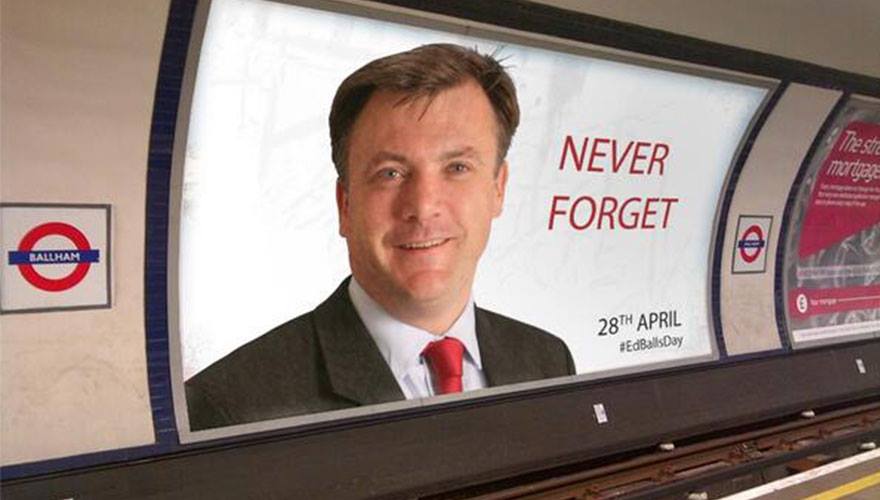
Ed Balls Day is a bit of fun and the stuff of nonsense. It celebrates and remembers the day (28 April 2011) when British politician Ed Balls tweeted his name thinking he was entering it into a search box.
Since then […] every year Twitter rejoices in the madness of the internet gaffe and marks Ed Balls Day.Source
A simple mistake has made him the Patron Saint of Simple Mistakes. To his credit, he hasn’t deleted the tweet, it remains on Twitter in all its pomp and glory, although at the time he didn’t know it was possible to delete them.
It’s a day to look forward to, it’s a day to enjoy with family and friends, it’s a day to share with others. It’s a day that unites everyone. Whatever your race, colour, or creed, everyone can enjoy Ed Balls Day.
Some bemoan the fact that’s it’s become too commercialised these days, having lost its true meaning. So, however you celebrate, make sure it’s significant.
Yes, it’s a bit of fun, but at its heart is the positive affirmation of simple mistakes and a willingness to own them.
Imagine you meet someone called Jack and, because of their chosen clothes and style, you’re not sure of their gender identity. Imagine then having speak to another person about them. In that instance, knowing their personal pronouns will enable you to refer to them correctly, not make an idiot of yourself, and save embarrassment all round.
Indicating your personal pronouns is an act of courtesy. Respecting someone’s personal pronouns is an act of thoughtfulness. No one is forcing it on you or anyone else. It’s nothing to get annoyed about. It’s about being better human beings, understanding of others.
Palm Sunday this year falls on the day we remember Óscar Romero, the Archbishop of San Salvador who championed the cause of the poor and marginalised. He was assassinated on Monday, 24 March 1980, at the age of 62.
So, instead of concentrating on the events of the first Palm Sunday, I’d like to celebrate Óscar Romero and learn from the life of this extraordinary man, a hero of faith, prayer, and justice.
Óscar Romero was the Archbishop of San Salvador at a time of terrible violence and oppression during El Salvador’s civil war. He was a contemplative and conservative man, but a fierce opponent of economic inequality and of the kidnapping, torture, and murder of his people.
He became a beacon of hope for the poor. Although his killers were never identified, it’s almost certain that Romero’s very public stand against the injustice of the military government was the reason he was shot dead as he celebrated Mass.
Romero saw that love can’t be theoretical, neither is it soft or weak, but there is a violence to love. Not a violence that hurts people, but a violence that resists anything that harms people. It stands up to the powers that exploit and destroy others; it’s this kind of love that Jesus demonstrated on the cross.
Read: Philippians 2:5-11 (one of the Lectionary Bible readings for today).
Óscar Romero wrote: “All of us, if we really want to know the meaning of conversion and of faith and confidence in another, must become poor, or at least make the cause of the poor our own inner motivation. That is when one begins to experience faith and conversion: when one has the heart of the poor, when one knows that financial capital, political influence, and power are worthless, and that without God we are nothing. To feel that need of God is faith and conversion.”
“The violence we preach is not the violence of the sword, the violence of hatred. It is the violence of love, of brotherhood, the violence that wills to beat weapons into sickles for work.”
On this Palm Sunday, let’s reflect on the life of Óscar Romero and consider how he followed Jesus, the one who rode into Jerusalem as the Prince of Peace.
St. Patrick’s Day, which falls on 17th March, is all about celebrating the legendary patron saint of Ireland, St. Patrick. He was actually born in Roman Britain way back in the late 4th century. He was kidnapped when he was just 16 and taken to Ireland to work as a slave, but he managed to escape. He later returned to Ireland around 432 CE with a mission, to convert the Irish to Christianity. He used a humble shamrock to explain the Holy Trinity, which eventually became a symbol of this day.
For over a thousand years, the Irish have been celebrating this day, sticking to their traditions. They usually start with a morning church service and then dive into festivities in the afternoon, especially since it falls during Lent when the rules about meat-eating get relaxed a bit. That means it’s time for some serious feasting on Irish classics like bacon and cabbage.
Interestingly, the first-ever St. Patrick’s Day parade didn’t happen in Ireland, but in America! Back in 1601, in a Spanish colony that’s now St. Augustine, Florida. And then in 1772, Irish soldiers in the English military based in New York City decided to honour St. Patrick with their own parade. Over the years, these parades became a big deal, showing off Irish pride among immigrants in America.
Fast forward to today, and St. Patrick’s Day is all about parades, wearing anything and everything green, and of course, indulging in delicious Irish food and drinks. It’s a massive celebration, not just in Ireland but all over the globe, especially in places with lots of Irish folks. But beyond the fun, it’s also a time to think about Irish heritage and culture.
Sure, over time, the day’s meaning might have shifted a bit, but it’s still all about honouring those Irish traditions and remembering the work St. Patrick did in spreading Christianity. Yeah, some people might grumble about how commercialised it’s become or how it sometimes plays into stereotypes, but for many, it’s a day of cultural pride and religious reflection, a reminder of the incredible legacy left by Ireland’s favourite saint.
Ever wondered why February gets an extra day every four years? Well, it’s all about keeping our clocks and calendars in sync with the Earth’s orbit around the sun. You see, our orbit takes approximately 365.2422 days, but the Gregorian calendar, which we use, only has 365 days. So, to make up for this discrepancy, we add leap years.
The idea of adding an extra day to February goes back to Julius Caesar’s time. Augustus Caesar later added two days to August, which caused February to lose out on its length.
Leap years happen every year that’s divisible by four, except for years divisible by one hundred but not by four hundred. This fine-tuning ensures our calendar stays accurate. The Gregorian calendar, introduced in 1582, made further adjustments by skipping three days every four hundred years. Additionally, leap seconds are occasionally added to align Earth’s rotation with atomic time and prevent drift.
Interestingly, leap years are also linked to the tradition of women proposing to men. This tradition stems from a 5th Century Irish legend involving St. Bridget and St. Patrick, and it gained popularity in Scotland in the 19th Century.
If you’re born on February 29, you’re called a leapling! In non-leap years, leaplings celebrate their birthdays on February 28 or March 1.
Popular culture has embraced leap years too. Works like Gilbert & Sullivan’s “Pirates of Penzance” and the film “Leap Year” explore leap year themes. While there’s no specific leap year cuisine, dishes like frogs’ legs and recipes involving the number four are often associated with leap year traditions.
Anthony, Texas, proudly calls itself the Leap Year Capital of the World and hosts a four-day festival every leap year. Superstitions about leap years are reflected in proverbs from various cultures, and some believe leap years bring bad luck for marriages.
Fun fact: Rare Disease Day is observed on February 29.
In conclusion, leap years play a crucial role in keeping our calendars accurate, and they’re woven into various cultural traditions and beliefs. So, every four years, let’s celebrate that extra day in February!
Today is the third Monday in January, a day designated as Blue Monday, the most depressing day of the year in the northern hemisphere.
Unfortunately, this trivial label damages our understanding of mental health, just for the sake of a superficial piece of clickbait. Yes, my title is itself clickbait, but if this article helps you to understand actual depression better it will have achieved its purpose.
We all know that in a normal year January can be a difficult month for our mental health (for a variety of reasons) but recent years have been tough. So, even though the concept of Blue Monday appears to make sense, I feel we should reject it even more this year. The very real challenges we face this January make my premise even stronger this year, Blue Monday just isn’t real.
You’ll hear people say that it’s been worked out using a ‘scientific formula’. In fact, it first appeared as part of an advertising campaign for a holiday company, hardly the rigorous, evidence-based approach we might expect. Even the person whose name was on the original press release has since distanced himself from Blue Monday, admitting he was paid to help sell holidays. He now campaigns against Blue Monday.
Having said all that, the date continues to surface every January, and is increasingly linked to mental health and depression. In fact, it’s simply a day when we’re all supposed to feel a bit down, but even that is far-fetched if you give it some thought and view it through the lens of common sense.
A few years ago, the charity Mind attempted to dispel the myth that Blue Monday had anything to do with depression.
Depression is NOT something that happens one day and disappears the next, as if it has trivial ’causes’. Blue Monday is mumbo jumbo, pseudoscience that only serves to add to damaging preconceptions about depression and trivialises a serious illness that can be life-threatening. Depression has nothing to do with the third Monday in January.
The idea that depression is basically the same as feeling low is very pervasive within society, as if it’s ’caused’ by trivial things with the ‘cure’ a matter of ‘pulling yourself together’. Facile responses to depression, such as ‘cheer up’, merely reinforce the preconception it can easily be shaken off with determination and effort. This is not the case, depression is NOT the same as having a bad day.
Depression is way more than simply feeling a bit low, and this is what’s difficult for some people to grasp. It’s about guilt, feelings of worthlessness, lack of motivation, and a sense of emptiness, with simple tasks seemingly impossible to achieve. But there’s also the physical symptoms; headaches, aches and pains, lack of appetite, and sleep disturbances. On top of this can come insidious suicidal thoughts.
It’s an insult to think that the mental and physical complexity of depression can be encapsulated in a catchy named day. The negative things in everyday life that get us down are NOT the things that cause depression, it’s NOT something ‘catch’ from our circumstances. Yes, they can affect our mental health adversely, but they don’t cause depression. Depression can happen in good times.
The ‘why’ of depression is a complex and multi-faceted question. Please don’t trivialise it by falling for a gimmick, reject Blue Monday!
Finally, here’s a Blue Monday we mustn’t reject, enjoy! Click here.
Oxford Dictionaries decided that the word post-truth (or is that two words?) should be Word of the Year for 2016. They defined it as an adjective ‘relating to or denoting circumstances in which objective facts are less influential in shaping public opinion than appeals to emotion and personal belief’. Two major news events of 2016 illustrated how untruths (or should I just say lies?) were an illustration of this; namely, the debate prior to the UK referendum vote to leave the European Union and the campaign that resulted in the election of Donald Trump in the United States of America.
Many people were surprised by these two events, and one explanation is the so-called social media bubble. This is a phenomenon which links us to like-minded friends and others, sharing and liking similar news stories, views, and opinions. The algorithms of Facebook (and the like) can decide our friends for us, as those with similar views. Yes, this goes on in the everyday world, but the effect is magnified by the very nature of the medium. It’s like living in an echo chamber.
Many were surprised by Brexit and Trump because they weren’t aware of many people who favoured them. They just weren’t in their circle of friends, or they possibly kept quiet. Add to this the problem of hoaxes, fake news and unreliable quotes, and things can get quite messy. What is truth in a post-truth world after all? Falsehoods are easily spread by people unwilling (or too busy) to make a simple check of their veracity. Google can be your friend, or possibly your false-friend, who knows anymore?
In the space of two days I heard both Brian Eno and Laurie Anderson speak about the feature on Amazon that shows what other people bought after you’ve made a purchase. Another example of the bubble effect? Wouldn’t it be better to have a reverse filter suggesting what they didn’t buy? We can so easily inhabit an echo chamber.
Shouldn’t we be reaching out those with different opinions to our own and seeking to understand?
Remembrance Sunday is observed on the second Sunday in November in the UK and some Commonwealth nations. It’s a day to honour and remember the sacrifices made by those who lost their lives in times of war. It holds deep significance for Christians, interweaving both historical and spiritual elements in its observance.
At the heart of the Christian faith lies the principle of love, echoed in Jesus Christ’s teachings to “love your neighbour as yourself.” Remembrance Sunday aligns with this core belief, emphasising the sacrificial love shown by soldiers and civilians who laid down their lives for the well-being of others. Christians view this sacrifice as reflective of Christ’s own sacrificial love, embodied in his death on the cross.
For many Christian denominations, the act of remembrance itself is profoundly rooted in their faith. It’s a time to reflect on the virtues of courage, selflessness, and service exemplified by those who served in the armed forces. Christians recognise and honour the dedication and commitment of these individuals, echoing Christ’s message of service to others.
Church services on Remembrance Sunday often incorporate themes of peace, reconciliation, and the call for a world free from conflict. The prayers and hymns during these services focus on the hope for peace, drawing inspiration from biblical passages that speak of peace and the cessation of violence. It’s a moment to pray for global peace and for the families who continue to suffer due to the consequences of war.
The act of remembrance, marked by the two-minute silence at 11.00 am, stands as a solemn acknowledgment of the sacrifice made by so many. This silence is an act of collective honour and gratitude, echoing the Christian value of reverence, humility, and thankfulness.
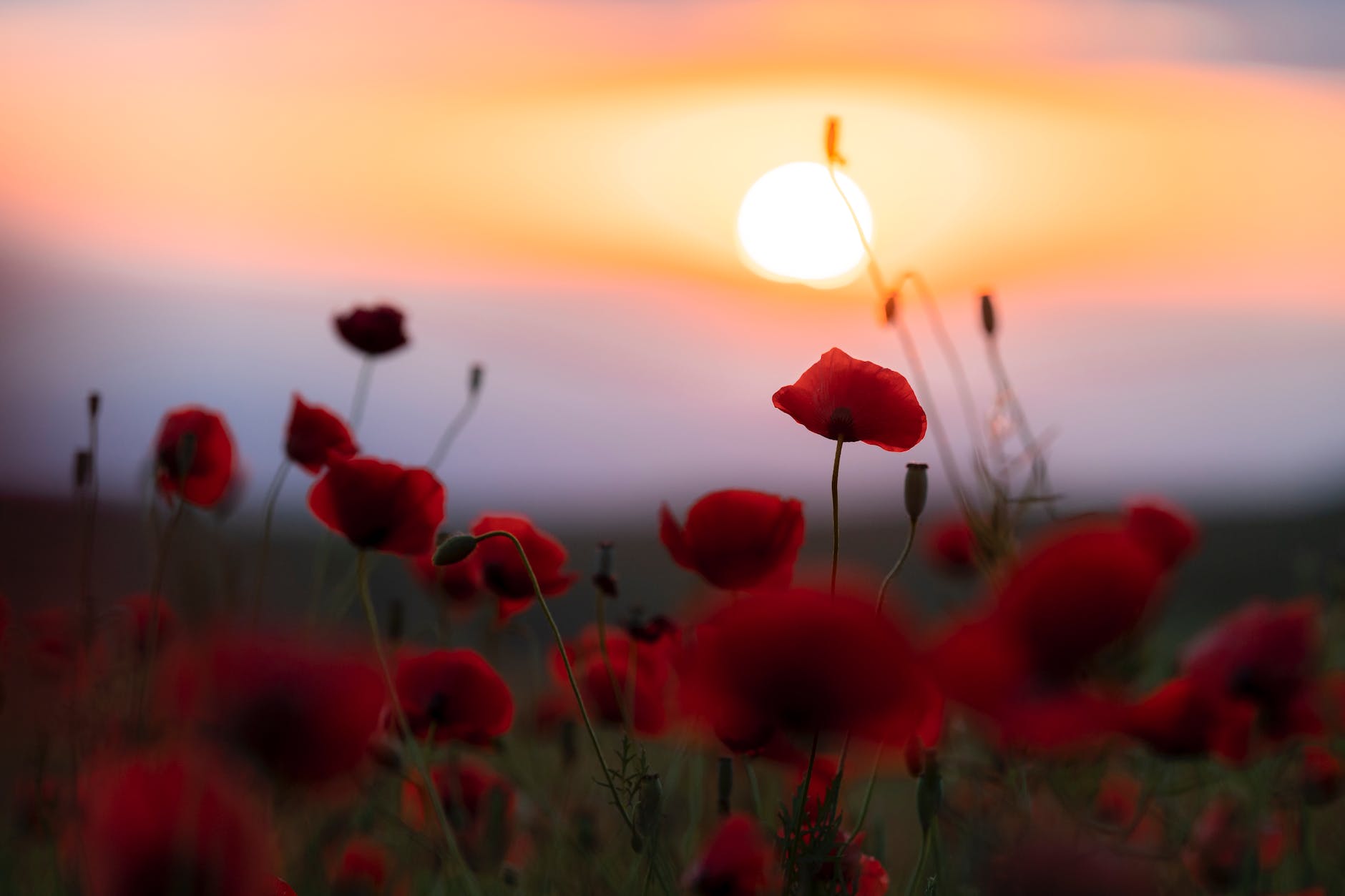
Moreover, the red poppy, often worn during this time, symbolises both loss and hope. While it signifies the bloodshed and sacrifices of war, it also represents the hope for a peaceful future. In a Christian context, the red poppy can be likened to the redemptive nature of Christ’s sacrifice, offering hope and renewal even in the face of immense suffering.
The Christian perspective on Remembrance Sunday also incorporates a plea for learning from history. It encourages reflection on the tragic consequences of war and the importance of pursuing peace, justice, and reconciliation. This aligns with the Christian ideals of forgiveness and understanding, emphasising the need to work towards preventing conflict and promoting harmony in society. Some wear a white poppy for this reason.
Ultimately, for Christians, Remembrance Sunday is a time to pay homage to the fallen, to reflect on the virtues of sacrifice, courage, and service, and to recommit to the pursuit of peace in a world often marred by conflict. It’s a day that highlights the interconnectedness of remembrance, faith, and the aspiration for a future guided by love, harmony, and unity.








 John Ager's Home on the Web!