The Bottle of Notes & MIMA

Tucked into the heart of Middlesbrough, the Bottle of Notes and the Middlesbrough Institute of Modern Art (MIMA) stand as two bold declarations that this proud post-industrial town has never lost its creative spark. Together, they form a kind of artistic gateway (one outdoors, one within) both inviting passers-by to pause, to look up, and to wonder.

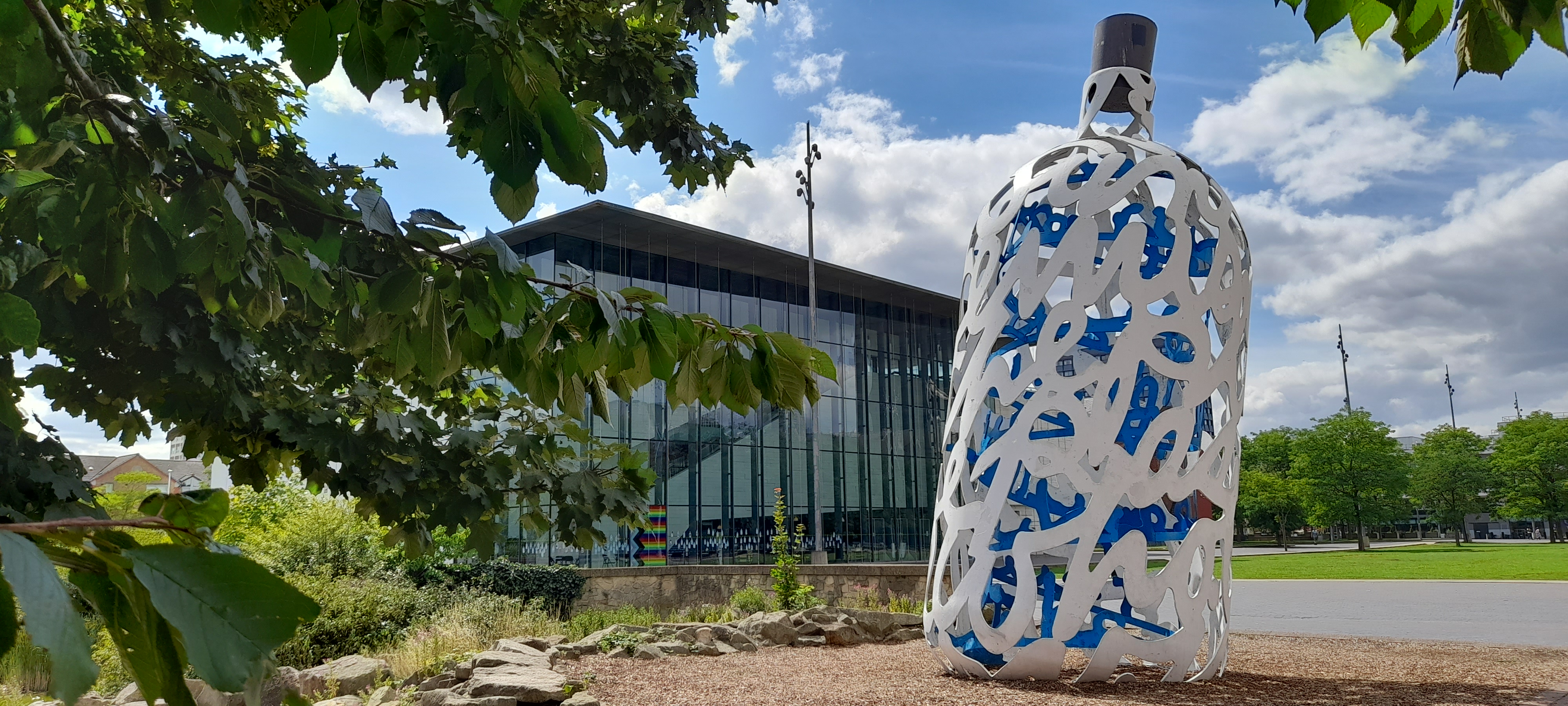
The Bottle of Notes, created by Claes Oldenburg and Coosje van Bruggen in 1993, was the UK’s first public sculpture by international artists of that stature. It’s a twisting, open steel bottle, standing over nine metres tall, scribed with words from the journals of Captain James Cook, one of Middlesbrough’s most famous sons. The sculpture weaves his words with Coosje’s own poetic reflections, looping them together in English and French. It’s as if the sculpture itself is a message tossed into the sea of public space: fragmentary, fluid, beautifully unexpected. You don’t just look at the Bottle, you walk around it, beneath it, inside its gentle chaos. And if you let the words wash over you, you might just catch a glimpse of adventure.

Just a short stroll away is MIMA, one of the UK’s leading contemporary art galleries. It opened in 2007 with a striking glass façade that reflects both the sky and the people walking past. Inside, it’s a thoughtful space that doesn’t shout, but listens. MIMA champions not just visual art, but social change. Its exhibitions range from internationally acclaimed artists to community-rooted projects that give voice to the region’s lived experience. It’s not a place where art sits on a pedestal, it’s where art meets life.

Together, the Bottle of Notes and MIMA tell a quiet but powerful story: that Middlesbrough is a place of imagination and resilience. In steel and glass, poetry and paint, they remind us that art can belong to everyone, and that every place, no matter its past, can shape a creative future.


Not Evil, Just Honest

Many consider the lyrics of Black Sabbath to be dark and sinister. In fact, nothing could be further from the truth. Beneath the heavy riffs and haunting vocals lies a band deeply concerned with the world’s injustices, the fragility of the human soul, and the dangers of unchecked power. Rather than glorifying evil, Black Sabbath often turned a critical eye on it: warning, questioning, and mourning rather than celebrating destruction.

Take War Pigs for example, often mistaken for a violent anthem, when in reality it’s a scathing critique of warmongers who send others to die in their place. The band pulls no punches in exposing the hypocrisy and cruelty of those in charge. Similarly, Children of the Grave isn’t a doom-laden chant, it’s a passionate plea for peace, calling on the younger generation to stand against hatred and build a better future. That doesn’t sound like a celebration of darkness; it sounds like a cry for light.

Even songs that touch on the supernatural or the occult often do so to explore fear, manipulation, and the unseen battles of the mind. Black Sabbath, the self-titled track, plays like a horror story, but it’s rooted in bassist Geezer Butler’s real experience of spiritual terror and questioning. These weren’t just theatrics; they were ways of giving shape to the anxieties and moral questions that many people wrestle with in a turbulent world.

Ozzy Osbourne’s delivery, haunting, plaintive, and raw, did more to convey human vulnerability than menace. His voice wasn’t that of a villain, but of someone looking around at a broken world and asking why it had to be that way.

Of course, the band’s image and sound were deliberately provocative. They wanted to grab attention, to jolt people out of complacency. But the heart of Black Sabbath wasn’t found in evil, it was in the warning, the lament, and the hope that maybe things didn’t have to stay this way. For all the thunder and gloom, their message was surprisingly human. And deeply compassionate.

Attention Moon Landing Deniers!

Healthy scepticism is important, and questioning what we’re told is a vital part of being human. But when it comes to the Moon landings, the evidence is so overwhelming, so beautiful in its scale and collaboration, to deny it is laughable.

Let’s start with this: the Apollo missions weren’t just a few astronauts and a secretive NASA control room. They involved over 400,000 people, scientists, engineers, programmers, builders, planners, many of whom weren’t even working in the same place or under the same leadership. To fake something of that size, and keep it hidden for over half a century, would require a conspiracy larger and more intricate than anything the world has ever seen. And that kind of silence? It just doesn’t happen!

But it’s not just about the people involved. We brought back rocks. Moon rocks. Not pebbles anyone could fake in a lab, but samples that have been studied and confirmed by independent scientists all over the world, including those in countries that weren’t exactly friendly with the USA at the time. These rocks are unlike anything we’ve found on Earth: their composition, age, and exposure to cosmic radiation tell a story that only the Moon could have written.

And then there’s the technology. Space agencies in other countries, Russia, China, India, have tracked and mapped the Moon using their own satellites. They’ve seen the sites. Some of these spacecraft have even captured images of the Apollo landers still sitting there, untouched, in the grey lunar dust. The reflectors the astronauts left behind still bounce laser beams back to Earth. You can test it yourself, if you’ve got access to the right equipment.

I understand the mistrust that fuels conspiracy theories. We live in a world where institutions have sometimes failed us, where secrets get kept and stories get twisted. It makes sense to wonder. But the Moon landings aren’t a lie. They’re one of humanity’s greatest stories, of courage, intelligence, teamwork, and imagination.

To believe we didn’t go sells short what we’re capable of. It turns a collective triumph into a cynical illusion. And maybe most tragically, it robs us of wonder. Because when we look up at the Moon, knowing we’ve stood there, not once, but six times, we get to feel something rare and precious – AWE!

And I don’t want to give that up!

The American Dream is Dead

This is a guest post from an American friend for Independence Day 2025.

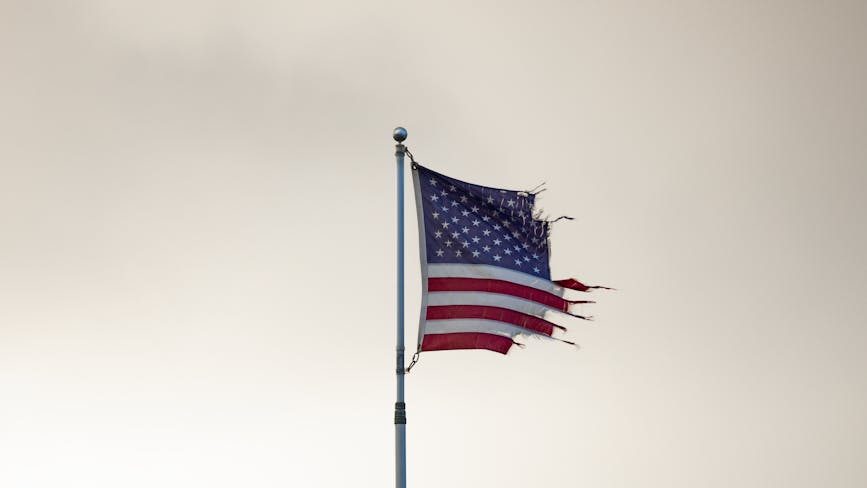
I’ve never been more disgusted and horrified by my country than I am today. Everything I was taught about what we stand for has been silenced or destroyed. We are actively harming people who come for a better life and making billionaires richer off the backs of the poor and the middle class. We are removing life sustaining care from people who desperately need it.

Cruelty and hatred are running the country. Fueled by stupidity and ignorance.

Nobody is coming to save America. The rest of the world sits baffled by how we could let this happen. They’re not coming.

The American Dream is dead.

It makes it worse to think what Independence Day represents. What brave people sacrificed in all kinds of ways so we could end up here.

If he’s gone, we still have the gigantic wave of hatred that elected him.

I cannot celebrate.

No Longer Hemmed In

Before faith came, we were hemmed in, watched over by the law like children under a guardian. Galatians 3:23–29 opens a door to freedom, wide and startling. Paul is urging his readers to see that something radical has happened: through Jesus, the old divisions no longer define us. The law had its time, a tutor for the soul, but now the classroom has given way to real life.

It’s easy to forget how fiercely people clung to those old boundaries. Jew or Gentile. Slave or free. Male or female. Each one had its place, each one a label heavy with meaning and consequence. But Paul writes with conviction, with fire: in Christ Jesus you are all children of God through faith. Not some of you. Not the ones who follow the right rituals or belong to the right tribe. All.

There’s something disarming about how Paul builds this argument, not by dismissing identity, but by transcending it. He doesn’t say that we all become the same, but that we all belong. To be clothed in Christ is to carry a new kind of dignity, one that isn’t earned or inherited but given.

For those of us trying to follow Jesus today, this passage is more than an ancient manifesto, it’s a call to live as if these words were true in our own community. To see no one as ‘other’. To listen harder, love better, and dismantle every hierarchy that says someone is less worthy. Paul isn’t offering cheap unity; he’s describing a deep, costly grace that reorders everything.

And maybe it’s also a challenge to look in the mirror. Where do we still live under the old rules? Where do we still draw lines (subtle or sharp) that divide and exclude? This isn’t about being ‘woke’ for the sake of it. It’s about being awake to the Spirit of God who knits us together, who refuses to let any of us stand alone.

If we truly belong to Christ, Paul says, then we are Abraham’s heirs. Not by blood, but by promise. A family bound not by sameness, but by the radical, unbreakable love of God.

Reject Christian Zionism

Christian Zionism is a religious, political, and military movement couched in biblical ideas and imagery. There are clearly wrong actions from both sides in the Israel/Palestine conflict; neither Hamas (for example) nor Israel is without blame, yet both have legitimate claims.

For me, Christian Zionism is negative and counterproductive in the movement for peace, as well as being contrary to the character of Jesus portrayed in the Gospels. It doesn’t advance the values of the Kingdom. The way of Jesus was one of vulnerability, supremely demonstrated on the Cross, not the way of triumphalism.

Indeed, Jesus condemned the nationalism of the Jews on the first Palm Sunday and rightly predicted the downfall of Jerusalem in 70 CE as a result. Peacemaking in this area of longstanding tension and conflict requires sensitive understanding and diplomacy, not unilateral action and triumphalism.

My genuine hope and prayer is for a two-state solution to this seemingly intractable conflict, where (as so often) it’s the innocent who suffer and die. In recent times, Hamas have been provocative, and Israel have overreacted. I weep as innocent suffering continues.

I’m neither anti-Israel nor pro-Palestine; I’m on the side of justice and peace for all, pro-humanity you could call it. Selective interpretation of the Bible is not in keeping with its overall message, the character of Jesus, nor the values of the Kingdom.

The Importance of Clean Water

In a world overflowing with technology and wealth, it’s easy to forget that millions of people still lack something as basic as clean water. That’s where WaterAid comes in, a quiet but determined force tackling one of the greatest injustices of our time.

Since 1981, WaterAid has worked to ensure that everyone, everywhere, has access to clean water, decent toilets and good hygiene. Not as a handout, but as a matter of dignity and human rights. It partners with communities across Africa, Asia, and Latin America, listening first, then helping to build lasting solutions; from wells and taps to toilets and hygiene education. It also campaigns tirelessly to get governments and institutions to prioritise these essentials.

The impact is transformative. A working tap in a village means children can go to school instead of fetching water. A toilet at home means privacy, safety and dignity; especially for girls and women. Clean water in a health clinic can mean the difference between life and death.

What makes WaterAid stand out is its commitment to sustainable, community-led change. It’s not just about infrastructure, it’s about justice, resilience, and hope.

In a time when global headlines often feel overwhelming, WaterAid offers something different: quiet, practical progress. One tap. One toilet. One transformed life at a time.

History Repeating

The 1930s in Germany began with a whisper of desperation and ended in a roar of destruction. In the shadows of World War I and the Great Depression, the German people were aching for stability, dignity, and hope. But what they got instead was a rising tide of far-right extremism that would plunge the world into its darkest abyss. The lessons of that decade still echo today, especially as far-right movements stir again across the globe, cloaked in new language but driven by the same old fears.

Germany’s democracy, the Weimar Republic, was fragile and battered. Inflation had shattered savings and unemployment soared. People were angry, disillusioned, and vulnerable to the promise of easy answers. Enter Adolf Hitler and the Nazi Party, a fringe movement that exploited the pain of a nation. With slogans about restoring greatness, purifying the nation, and crushing enemies from within, they wrapped fear in patriotic colours and made hatred feel like a duty.

When Hitler was appointed Chancellor in 1933, he moved fast. Civil liberties evaporated, the press was muzzled. Political opponents were silenced, imprisoned, or killed. The Nazis used propaganda not just to inform, but to mold reality itself – painting Jews, communists, intellectuals, and the disabled as threats to be neutralised. Step by step, they turned neighbours into enemies and bystanders into accomplices. The churches, too, wrestled with compromise and complicity, and many chose silence rather than risk.

At its heart, this was not just a German tragedy, it was a human one. It was about what happens when fear outweighs compassion, when power goes unchecked, and when a people forget that the stranger at the gate is often just a reflection of themselves.

And here we are again…

Across continents today, we hear echoes of that decade: the rise of nationalism that scapegoats the weak, the nostalgia for a glorified past that never truly existed, the distrust of the press, and the sneering disdain for democratic norms. We see it in the chants at rallies, in the conspiracies that spread like wildfire, in the tightening of borders and the loosening of empathy. The faces and flags have changed but the spirit is familiar: an idolising of strength, a demonising of difference.

Yet history doesn’t repeat itself word for word, it rhymes. And the echo of the 1930s isn’t a prophecy, but a warning. It tells us that democracy isn’t a given, it must be guarded. That kindness isn’t weakness, it’s the foundation of any society worth building. When we believe “it can’t happen here” we’ve stopped paying attention.

Light always begins small: a candle, a voice, a hand reaching out. But so does darkness. The far-right grew not just because of violence, but because of indifference. And that, more than anything, is what history urges us to resist. We must stay awake. We must speak up. We must remember.

Because the past is not dead, it waits to be repeated if we let it.

VE Day: Resilience in Modern Times

While it’s important to be cautious when comparing today’s world with the era of the Second World War, there are still meaningful lessons to be drawn. VE Day in 1945 symbolised more than just the defeat of a visible enemy; it also marked a triumph over destructive ideologies and deeply rooted fear. In our time, we face different but equally serious threats, ones that may not involve tanks or bombs but still cause disruption and anxiety. Misinformation, manipulation, and attacks on truth are among today’s adversaries. Had social media existed during the war, it likely would have become another front in the struggle for clarity and trust.

Just as people then had to remain alert to defend hard-won freedoms, we too must guard the values we often take for granted. The suffering endured during the war defies comprehension, yet today we continue to see suffering, though in different forms. Many are grieving, many are struggling, and often due to circumstances beyond their control. The threats we face now are not always visible but still challenge our sense of safety and stability. In such times, it becomes even more important to support and uplift each other, to offer reassurance in the face of uncertainty.

Not everyone greeted VE Day with simple joy. Though the war had ended, hardship remained. Food rationing continued, and the task of rebuilding was immense. Likewise, in our age, recovery from recent problems will not be immediate. But we can take inspiration from the resilience and courage shown then. Alongside the heroes of the past, we must celebrate those who serve society today, health workers, teachers, public servants, and countless others who keep daily life going. One of the greatest post-war legacies, the NHS, remains a powerful symbol of care and hope. So today, as we reflect, it’s worth asking: who are your heroes now? And how can you be a source of strength for someone else in the days to come?

VE Day 2020 (Republished)

large_000000

Whilst acknowledging the need to tread carefully and sensitively in any comparisons between the Second World War and the current coronavirus pandemic, I believe there are some useful ones we can make to help us in our thought processes and thereby benefit our collective mental health.

VE Day in 1945 reflected a victory over a visible enemy, although also an invisible enemy of evil thoughts and ideas. The enemy we face now is totally invisible and does not care one iota for those it harms. Fake news is not new, they faced it back then; had they had social media, that would simply have been another front on which the war would have been fought. Today, not only in the coronavirus pandemic, we face a war against those who would deceive us. We need to guard our way of life against those who would lie to us, who seek to destroy the freedoms won for us then.

The Second World War was marked by terrible suffering, the like of which is hard to process, along with the inhumanity of it all. Today, many have been devastated by an invisible enemy, and we pause to remember the lives lost and the families and friends grieving.

Back then the world faced life-treatening jeopardy and, for many today, this is the first time we have faced real jeopardy. Yes, I remember the Cold War, but that’s the only threat that comes anywhere near what we face today. There’s fear and anxiety everywhere, and so we need to affirm, encourage and support each like never before. It’s the same for everyone, yet we all have unique circumstances and all react individually.

Back then, not everyone was celebrating, and for those who were it was only a brief celebration. The world faced an uncertain future and there was much rebuilding to be done, it was many years until food rationing was eased for example. In our own time, we might celebrate relaxations to the lockdown, but we still face the reality of an uncertain future and the prospect of rebuilding society. Then it was a collective experience, so it is today and will be for us. I’m neither being optimistic nor pessimistic; just realistically reflecting that there’ll be much to do in the coming weeks, months and years.

Today we celebrate the heroes of yesterday’s battles, but we also celebrate the new heroes in the NHS and all the key workers fighting a very different battle today. Come to think about it, the creation of the NHS was one of the great rebuilding efforts after WWII, and we are reaping its benefits today.

Who are you celebrating today? What can you do to help and support someone today and in the uncertain future?

Postscript: Today is ‘Victory IN Europe Day’, not ‘Victory OVER Europe Day’ as some history revisionists are suggesting for their own agendas.

Note: I chose the photo for this post because it reminds me of my two youngest girls, Pollyanna (2) and Matilda (3).

Photo Credit: VE DAY IN LONDON, 8 MAY 1945 (HU 49414) Two small girls waving their flags in the rubble of Battersea, snapped by an anonymous American photographer. Copyright: © IWM.

Source: http://www.iwm.org.uk/collections/item/object/205018927