Advent Christ is Born

Christmas Day brings the fulfilment of every Advent longing. The waiting, the watching, the yearning find their answer in a child wrapped in cloths and lying in a manger. Here, in the most ordinary of places, heaven bends low and touches earth. The Word, through whom all things were made, takes on our frailty, our flesh, our story. Advent Christ is born.

The angels can’t keep silent. They break open the night sky with their song: “Glory to God in the highest heaven, and on earth peace to those on whom his favour rests.” Shepherds hurry from their fields, astonished that the good news is for them – poor, unprepared, overlooked – and yet chosen to be first witnesses of glory. Mary treasures all these things in her heart, as love made flesh rests in her arms.

This birth is no sentimental tale but a revolution of grace. God comes not in splendour or might, but in humility, to show that his kingdom is for the lowly and the broken, for those who hunger for mercy and long for hope. “The Word became flesh and made his dwelling among us.” Not far off, not distant, but here – pitching his tent in the middle of our lives.

The candlelight of Advent now gives way to the blaze of Christmas morning. All the themes we’ve carried – hope, peace, joy, love – find their centre in Christ himself. He is the light that darkness cannot overcome, the peace that passes understanding, the joy that sings even in sorrow, and the love that will never let us go.

So we kneel with the shepherds, we rejoice with the angels, we wonder with Mary and Joseph, and we open our hearts to receive him. Advent Christ is born: God with us, now and always.

On Christmas Eve

Christmas Eve arrives quietly, like breath on cold glass. The world slows, even if only for a moment, and listens. Streetlights glow a little softer, kitchens carry the memory of cinnamon and warmth, and the dark feels less like an ending and more like a cradle.

This is the night between, between longing and fulfilment, between promise and presence. We stand with tired hearts and hopeful hands, carrying the year we’ve lived, its griefs and its small, bright joys. Nothing needs to be fixed tonight. Nothing needs to be proven. Love doesn’t hurry.

Somewhere beneath the noise, a deeper truth hums. God doesn’t arrive with spectacle or certainty, but with vulnerability. Not above the mess, but within it. A child’s cry breaks the silence, and the universe leans in. Power chooses tenderness. Eternity borrows time.

Christmas Eve invites us to rest in that holy nearness. To believe that light can be born in the darkest places, including our own. To trust that gentleness is never wasted, and that hope, however fragile, is enough to carry us through the night.

So we wait. Candles ready. Hearts open. Tomorrow will come. For now, this is enough.

The Jewish Festival of Hanukkah

Today, 15 December in 2025, Jews around the world gather to celebrate the first day of Hanukkah, a festival rich in memory, meaning, and light. As winter deepens and days feel short and fragile, Hanukkah arrives as a quiet but resilient act of hope. It recalls a moment when faith was threatened by oppression and conformity, and when a small community chose courage, identity, and trust over fear.

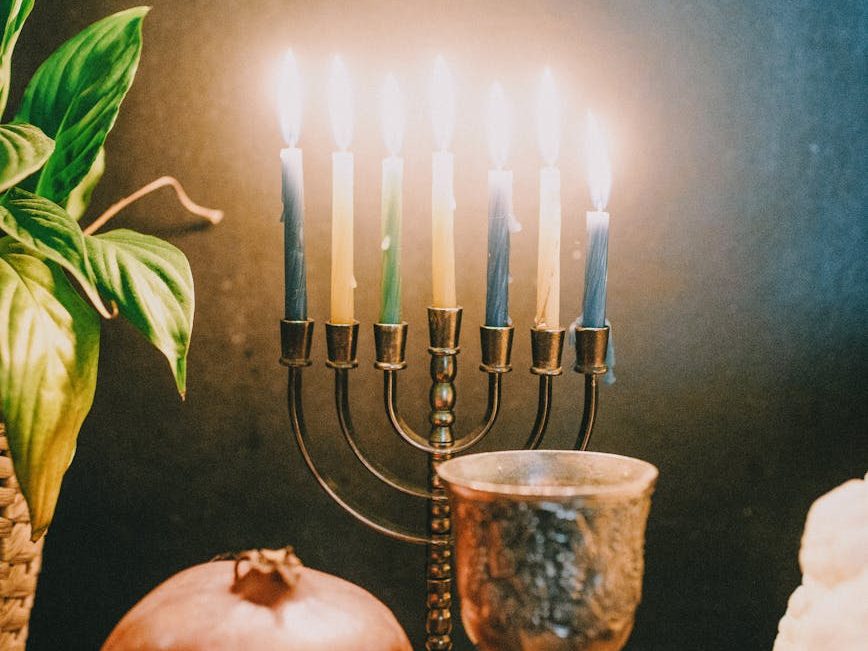
At the heart of Hanukkah is the lighting of the menorah, one candle on the first night, growing steadily brighter as each evening passes. It’s a gentle ritual, yet deeply powerful, reminding those who take part that light doesn’t need to be overwhelming to be transformative. Even a single flame can push back darkness, can offer warmth, can be seen from a window and shared with the world outside.

The festival remembers the rededication of the Temple in Jerusalem and the story of the oil that should have lasted one day but burned for eight. Whether heard as history, tradition, or sacred story, it speaks of endurance beyond expectation, of provision where none seemed possible. It invites reflection on what it means to stay faithful when resources are thin and the odds feel stacked against you.

Hanukkah is also a time of joy, family, food, song, and storytelling. Children play games, gifts are exchanged, and tables are filled with foods fried in oil, celebrating abundance in the midst of scarcity. In a fractured world, Hanukkah offers a steady, luminous reminder that identity matters, hope endures, and light, patiently tended, can still change everything.

Note: The date of Hanukkah changes each year because it follows the Jewish calendar rather than the Gregorian calendar used by most of the world. The Jewish calendar is lunisolar, shaped by both the moon and the sun. Months begin with the new moon and last 29 or 30 days. Hanukkah always starts on the 25th day of the Hebrew month of Kislev, but because the Jewish year doesn’t match the length of the solar year, the festival shifts when mapped onto the Gregorian calendar. To keep festivals in their proper seasons, the Jewish calendar occasionally adds an extra month. This prevents celebrations from drifting through the year, but the exact Gregorian date still varies, usually falling in late November or December. So while Hanukkah’s timing is fixed within Jewish tradition, it appears to move each year on modern calendars, reflecting an ancient, carefully balanced way of marking time.