No Longer Hemmed In

Before faith came, we were hemmed in, watched over by the law like children under a guardian. Galatians 3:23–29 opens a door to freedom, wide and startling. Paul is urging his readers to see that something radical has happened: through Jesus, the old divisions no longer define us. The law had its time, a tutor for the soul, but now the classroom has given way to real life.

It’s easy to forget how fiercely people clung to those old boundaries. Jew or Gentile. Slave or free. Male or female. Each one had its place, each one a label heavy with meaning and consequence. But Paul writes with conviction, with fire: in Christ Jesus you are all children of God through faith. Not some of you. Not the ones who follow the right rituals or belong to the right tribe. All.

There’s something disarming about how Paul builds this argument, not by dismissing identity, but by transcending it. He doesn’t say that we all become the same, but that we all belong. To be clothed in Christ is to carry a new kind of dignity, one that isn’t earned or inherited but given.

For those of us trying to follow Jesus today, this passage is more than an ancient manifesto, it’s a call to live as if these words were true in our own community. To see no one as ‘other’. To listen harder, love better, and dismantle every hierarchy that says someone is less worthy. Paul isn’t offering cheap unity; he’s describing a deep, costly grace that reorders everything.

And maybe it’s also a challenge to look in the mirror. Where do we still live under the old rules? Where do we still draw lines (subtle or sharp) that divide and exclude? This isn’t about being ‘woke’ for the sake of it. It’s about being awake to the Spirit of God who knits us together, who refuses to let any of us stand alone.

If we truly belong to Christ, Paul says, then we are Abraham’s heirs. Not by blood, but by promise. A family bound not by sameness, but by the radical, unbreakable love of God.

Running in Hot Weather

Running in hot weather can be tough, but with a bit of preparation and a sensible approach, it can still be enjoyable.

First, accept that the heat will affect your performance. That’s normal. You’re not slower because you’re unfit, you’re slower because your body is working harder to keep cool. Adjust your expectations. Focus on finishing comfortably rather than chasing a personal best.

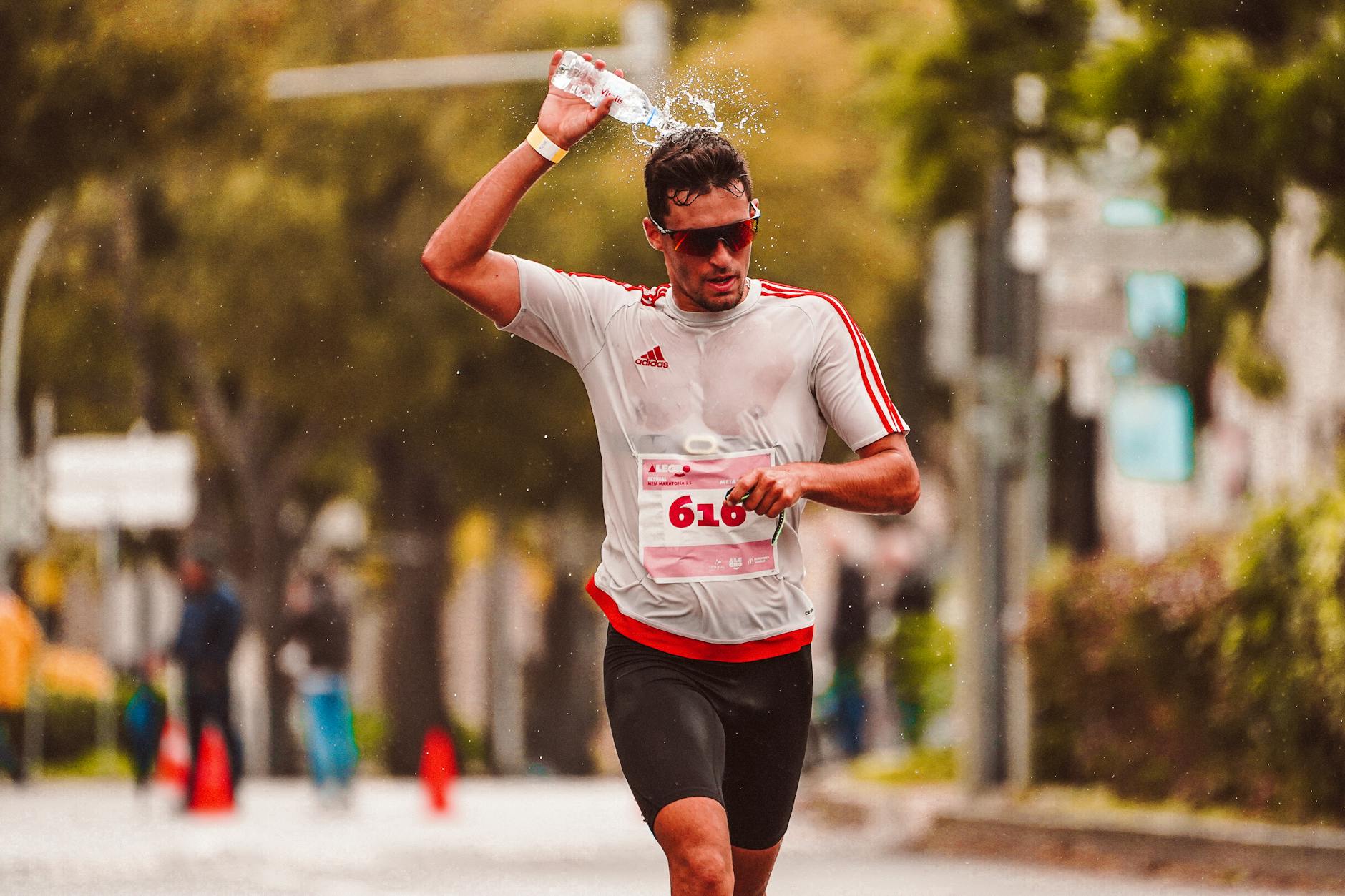
Hydration matters. Try to drink water before you arrive, not just on the morning itself, but the day before as well. If you’re well hydrated at the start line, you’ll feel much better on the course. Consider running with a water bottle.

Clothing makes a difference. Choose lightweight, breathable kit in light colours, and avoid cotton as it holds on to sweat. A cap or visor helps keep the sun off your face, and sunglasses can make a surprisingly big difference to how comfortable you feel.

Warming up is still important, but in hot weather it doesn’t need to be long. A brisk walk, some dynamic stretches, or a slow jog is enough to get moving without overheating before the run starts.

Once you’re running, listen to your body. If you need to slow down or take walking breaks, that’s absolutely fine. Many runners do this, especially in summer.

After the run, rehydrate and try to find some shade. A cool drink and a gentle stretch can help avoid post-run fatigue later in the day.

Running in hot weather isn’t about pushing through discomfort, it’s about being smart, staying safe, and enjoying the experience. The heat brings a different kind of challenge, but it doesn’t have to take away the joy. You’re still getting out there, still part of something positive. That’s what counts.

Staying Hydrated

When the sun’s high and the air feels heavy, staying hydrated becomes more than just good advice, it’s survival. Not every drink helps, though. Some replenish and restore. Others leave us thirstier than before.

Water, as always, is king. Cold or not, sipped steadily through the day, it quietly does exactly what we need. But sometimes, especially after lots of sweat or activity, water needs a little backup.

That’s where oral rehydration solutions come in. With the right mix of salts and sugars, they help your body absorb water more efficiently, perfect after a long run, garden work, or a pounding headache.

Coconut water’s another gentle ally: full of potassium, lightly sweet, and refreshingly natural. It’s a lovely alternative to sugary sports drinks. Herbal teas, cooled and poured over ice, also work wonders, peppermint or hibiscus are especially refreshing and caffeine-free.

Diluted juice (half juice, half water) gives flavour and a little natural sugar, without overwhelming. And don’t underestimate milk. Cold, semi-skimmed, it’s surprisingly good at rehydration, especially after activity.

Infused water can also lift the ordinary. Add cucumber, mint, berries, or citrus, suddenly water’s more inviting, more likely to tempt you for another glass.

Avoid alcohol, fizzy sodas, and high-caffeine energy drinks. They might seem refreshing, but they quietly take more than they give.

Hydration isn’t about gulping gallons. It’s about listening, sipping often, and choosing drinks that care for your body, especially when the world turns hot.

A Mystery to Inhabit

Peace lingers in the air after Pentecost, like the last notes of a song that refuses to fade, followed closely by Trinity Sunday, not a puzzle to be solved but a mystery to inhabit. In Romans 5:1–5, Paul doesn’t outline the Trinity with neat precision, he simply invites us into the flow of grace, the dance of divine love.

We have peace with God through our Lord Jesus Christ, he writes, like someone who knows the ache of striving and the relief of being held. Through Jesus, we’re drawn into the life of God, not as spectators, but participants. This isn’t theory, it’s encounter. It’s the Spirit pouring love into our hearts like warm rain into cracked soil.

We often think of the Trinity as a doctrine, but Paul shows us a relationship. The Father, the Son, the Spirit, distinct yet united in purpose, moving toward us in love. The Father initiates, the Son reconciles, and the Spirit indwells. And somehow, this divine communion becomes the ground we stand on, the grace in which we now live.

Paul doesn’t promise an easy path. Suffering is real, but hope is too. And it’s not a vague, wishful kind of hope. It’s a hope forged in the fire of endurance, tested by waiting, and anchored in love that doesn’t disappoint. That’s the Spirit’s quiet work; reminding us that we’re not alone, that love surrounds us, and that grace isn’t earned but given.

On this Trinity Sunday, maybe we don’t need to grasp it all. Maybe it’s enough to be caught up in the mystery; to feel the peace of the Father, the welcome of the Son, and the presence of the Spirit. To rest in the truth that God is love, and love has made its home with us.

Reject Christian Zionism

Christian Zionism is a religious, political, and military movement couched in biblical ideas and imagery. There are clearly wrong actions from both sides in the Israel/Palestine conflict; neither Hamas (for example) nor Israel is without blame, yet both have legitimate claims.

For me, Christian Zionism is negative and counterproductive in the movement for peace, as well as being contrary to the character of Jesus portrayed in the Gospels. It doesn’t advance the values of the Kingdom. The way of Jesus was one of vulnerability, supremely demonstrated on the Cross, not the way of triumphalism.

Indeed, Jesus condemned the nationalism of the Jews on the first Palm Sunday and rightly predicted the downfall of Jerusalem in 70 CE as a result. Peacemaking in this area of longstanding tension and conflict requires sensitive understanding and diplomacy, not unilateral action and triumphalism.

My genuine hope and prayer is for a two-state solution to this seemingly intractable conflict, where (as so often) it’s the innocent who suffer and die. In recent times, Hamas have been provocative, and Israel have overreacted. I weep as innocent suffering continues.

I’m neither anti-Israel nor pro-Palestine; I’m on the side of justice and peace for all, pro-humanity you could call it. Selective interpretation of the Bible is not in keeping with its overall message, the character of Jesus, nor the values of the Kingdom.

When the Spirit Comes

The wind came first, wild and unexpected, like breath catching in the throat before tears fall or laughter bursts free. It swept through the house where they waited, not knowing quite what they were waiting for. And then came fire. Not the kind that destroys, but the kind that purifies, illuminates, ignites. Resting on each of them like a touch that said: you, yes you too. That’s how it began.

Pentecost always takes us by surprise. It doesn’t follow our rules. It doesn’t wait politely for permission. It arrives with power and presence, inviting chaos, courage and change. The Spirit doesn’t stay locked in sanctuaries or whispered prayers. It spills out, into the streets, into different tongues, into messy, marvellous humanity.

Some mocked, of course. They always do. “They’ve had too much wine,” they said, shaking their heads. But Peter, who not long before had denied even knowing Jesus, now stood tall. Not with arrogance, but with clarity. This is what the prophet Joel had said would happen: that God would pour out his Spirit on all people, that sons and daughters would prophesy, that young men would see visions and old men dream dreams. Even slaves, both men and women, would be filled with the Spirit, and they too would speak with heaven’s authority.

It’s tempting to domesticate Pentecost, to turn the Spirit into a gentle breeze or a polite nod to diversity. But Acts 2 refuses that. This is no quiet moment. This is revolution, resurrection, revelation. It’s the promise that no one is left out and nothing will be the same.

And maybe that’s what we long for, deep down, to be set alight, to speak and be heard, to see visions that lift us out of the grey. Not to escape the world, but to love it better, bolder, truer.

So come, Holy Spirit. Not just for them, back then, but for us, right now. In our confusion, in our waiting, in our small upper rooms and our crowded streets. Come with wind. Come with fire. Come with the language of love that everyone can understand.

Spirit of the living God, fall afresh on us, and make us brave with love.

Matthias or Paul?

After Jesus’ Ascension, the disciples faced the task of replacing Judas Iscariot. In Acts 1:15–17, 21–26, they chose two men, Joseph called Barsabbas and Matthias, then prayed and cast lots, and the lot fell to Matthias. He was added to the eleven apostles, but interestingly, this is the last time Scripture mentions him. There’s no record of his ministry or influence in the early church.

This raises the question: was choosing Matthias truly God’s will, or a well-intended human decision? While casting lots was an accepted practice at the time for discerning God’s will, perhaps this was an instance of acting too soon, of moving ahead of God’s timing. The apostles prayed, yes, but they also acted before the Holy Spirit had come at Pentecost. Did they mistake activity for obedience?

As the story unfolds in Acts, it becomes clear that God had someone else in mind, Saul of Tarsus. A fierce persecutor of Christians, Saul was completely outside the disciples’ consideration. Yet in Acts 9:1–19, God stops him on the road to Damascus, blinds him, transforms him, and sets him on a path to become Paul, the apostle to the Gentiles.

Paul became the dominant voice in the early church. His letters make up a significant portion of the New Testament. The Life Application Bible even notes that no one, apart from Jesus, shaped Christianity more than Paul. His passion, once used against the church, was redirected for the gospel. Clearly, God’s plan was far greater than what the disciples could have imagined.

This story highlights how easy it is to make ‘Matthias-type’ decisions, rushed, reactive choices that may seem spiritual but aren’t fully surrendered to God’s timing or Spirit. How often do we make decisions out of pressure, impatience, or a need to check a box, then ask God to bless what we’ve already chosen?

Yet God’s timing is perfect. Sometimes the best thing we can do is wait, pray, and live in the tension of not knowing. God often works in the unlikely, the unseen, and the slow. He chose Paul when no one else would have, reminding us that his plans surpass human logic.

Still, we shouldn’t assume Matthias had no purpose. Just because Scripture doesn’t record his story doesn’t mean God didn’t use him. Many faithful servants throughout history have gone unnamed, but they’ve played vital roles in God’s kingdom. Not everyone is called to be a Paul, but all are called to be faithful.

Whether we feel like a Matthias or a Paul, the invitation is the same: to seek God’s will, to wait when needed, and to trust that he has a purpose for each of us. Even when our role seems small or hidden, God sees it, and uses it, for his glory.

The Importance of Clean Water

In a world overflowing with technology and wealth, it’s easy to forget that millions of people still lack something as basic as clean water. That’s where WaterAid comes in, a quiet but determined force tackling one of the greatest injustices of our time.

Since 1981, WaterAid has worked to ensure that everyone, everywhere, has access to clean water, decent toilets and good hygiene. Not as a handout, but as a matter of dignity and human rights. It partners with communities across Africa, Asia, and Latin America, listening first, then helping to build lasting solutions; from wells and taps to toilets and hygiene education. It also campaigns tirelessly to get governments and institutions to prioritise these essentials.

The impact is transformative. A working tap in a village means children can go to school instead of fetching water. A toilet at home means privacy, safety and dignity; especially for girls and women. Clean water in a health clinic can mean the difference between life and death.

What makes WaterAid stand out is its commitment to sustainable, community-led change. It’s not just about infrastructure, it’s about justice, resilience, and hope.

In a time when global headlines often feel overwhelming, WaterAid offers something different: quiet, practical progress. One tap. One toilet. One transformed life at a time.

Unknown Pleasures (1979)

Unknown Pleasures is the debut album by English post-punk band Joy Division, released on 15 June 1979 by Factory Records. Recorded over three weekends at Strawberry Studios in Stockport with producer Martin Hannett, the album’s sound was shaped by Hannett’s experimental techniques, lending it a haunting, atmospheric quality that set it apart from the raw energy of punk.

The stark black-and-white cover, designed by Peter Saville, features a pulsar signal graph and has since become an iconic image in music and fashion. Musically, the album is steeped in post-punk’s brooding textures, driven by Peter Hook’s melodic basslines, Bernard Sumner’s sharp guitar work, Stephen Morris’s mechanical drumming, and Ian Curtis’s deep, anguished vocals. Curtis’s lyrics, dark, poetic, and introspective, grapple with themes of isolation, disintegration, and despair, mirroring the gritty atmosphere of late ’70s Manchester.

Opening with the urgent pulse of Disorder, the album unfolds into a sequence of emotionally intense tracks. She’s Lost Control, influenced by Curtis’s struggles with epilepsy, delivers a cold, hypnotic groove, while Shadowplay and New Dawn Fades highlight the band’s ability to fuse relentless rhythm with emotional weight.

Though no singles were released from it, Unknown Pleasures gained acclaim for its innovation and mood, gradually growing in stature to become one of the most influential albums in modern music. It helped define the post-punk movement and inspired generations of artists with its bleak beauty.

Joy Division formed in 1976 in Salford after seeing the Sex Pistols perform. Originally called Warsaw, the band changed its name to Joy Division in 1977. Their first release, An Ideal for Living, led to their signing with Factory Records and the recording of Unknown Pleasures.

Tragically, this would be the only Joy Division album released during Ian Curtis’s lifetime. He died by suicide on 18 May 1980, just before their first American tour. The surviving members later formed New Order, continuing the legacy. Unknown Pleasures endures as a powerful, emotionally resonant work that continues to captivate listeners.

New World of Hope

In one of the final visions recorded in Revelation, John is shown a glimpse of the world as it will be when God’s work of redemption is complete. The old world vanishes and John sees something completely new, a new heaven and a new earth. The first ones are gone. Even the sea, often a symbol of chaos and distance, is no longer there. Then, coming down like a beautiful bride, a new Jerusalem appears, shining with the closeness of God. (Revelation 21:1-6).

This isn’t just a new scene, it’s redemption brought into full view. A loud voice declares, Look! God now lives with his people. Not visiting from time to time, not hidden in mystery, but living with us. As he once walked in the garden, he will walk with us again, no barrier, no distance, just face to face.

What follows is full of kindness. The one on the throne isn’t giving commands, he’s gently wiping away tears like a father who’s seen every hurt. And he doesn’t just comfort, he removes the reason for pain. Death will be gone. So will mourning, crying, and suffering. All of that belonged to the old world, and it’s over. There’ll be no sorrow in eternity. Heaven isn’t only gold and beauty; it’s a place where grief no longer exists.

Then comes a bold promise: I am making everything new! A promise so certain it’s written down, backed by the one whose word is always true. And maybe the most tender line of all: To the thirsty I will give water without cost from the spring of life. He knows our thirst, the deep, quiet ache that nothing else can reach, and he offers himself freely. No effort to earn it, no price to pay – just grace, poured out for the weary.

This is the hope that holds us steady. The story won’t end in ruin, but in glory. Not in loss, but in the joy of his presence. He’s the beginning and the end. And in him, we find our home.

See also: The Book of Revelation