How to be a Peacemaker

Peace is a wonderful state of being free from conflict, violence, and war. It’s a condition of harmony, tranquility, and stability that we all strive for. In a broader sense, peace is a universal human aspiration that transcends geographical boundaries, cultures, and ideologies. It’s a fundamental human need that’s essential for individual and collective well-being.

Internal peace is a state of inner calm and contentment, free from mental and emotional turmoil. It’s a state of being that allows individuals to feel at peace with themselves and their surroundings. Imagine being able to wake up every morning feeling refreshed, renewed, and ready to take on the day.

On the other hand, external peace is a state of harmony and stability in relationships, communities, and societies. It’s a state where individuals and groups can live together in mutual respect and understanding. Just think about it – a world where everyone gets along, and we can all live in harmony with one another.

Global peace is a state of international cooperation, understanding, and peaceful resolution of conflicts. It’s a state where nations and international organizations work together to address common challenges and promote peace and stability. Can you imagine a world where countries put aside their differences and work together for the greater good?

Achieving peace requires effort and commitment from individuals, communities, and nations. It involves promoting understanding, tolerance, and empathy, as well as addressing the root causes of conflict, such as poverty, inequality, and injustice. We can all play a role in creating a more peaceful world by being kind, compassionate, and open-minded.

Peace is a dynamic and ongoing process that requires continuous effort and dedication. It’s not a static state that can be achieved once and for all, but rather a continuous journey that requires constant attention and commitment. But the benefits of peace are so worth it – improved mental and physical health, increased economic growth and development, enhanced social cohesion and community engagement, and greater international cooperation and understanding.

So, let’s work together to create a more peaceful and harmonious world where individuals and communities can thrive. We can do this by educating ourselves and others about the importance of peace, engaging in respectful dialogue, and promoting human rights and dignity. Together, we can make a difference and create a brighter, more peaceful future for all.
Operation Raise the Colours

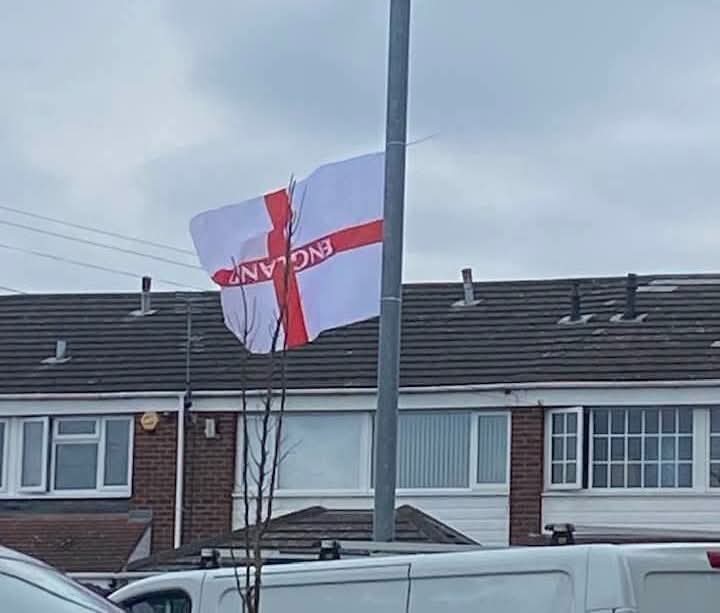
In the UK right now, there’s a debate about people flying the national flag. It began when far-right groups launched a campaign called Operation Raise the Colours, encouraging everyone to display the Union Jack or England’s St George’s Cross to show pride in being British.

The problem is that many people see this campaign as less about healthy patriotism and more about exclusion. The far-right origins have made some feel the flags are being used to divide communities rather than unite them.

Former England footballer Gary Neville spoke about this recently. He said he took down a flag from one of his buildings because he felt it was being used “in a negative way.” His comment sparked strong reactions – some agreed with his stance, while others accused him of being unpatriotic, and worse.

So the discussion isn’t really about the flag itself, but about what it symbolises at this moment – pride or prejudice.

Words Shape Our Future

Free speech is the foundation of democracy, because it allows people to express their thoughts, beliefs, and convictions without fear of repression or punishment. It ensures that every voice, whether popular or unpopular, has the right to be heard and considered. If we silence those we disagree with, we not only diminish the richness of public debate but also risk creating an environment where only certain viewpoints are tolerated, which undermines the very principles of freedom and equality that democracy is built upon. True progress comes through discussion, challenge, and the exchange of ideas, even when those ideas make us uncomfortable or force us to reflect more deeply.

That said, freedom of speech isn’t freedom from responsibility. Words have power. They can enlighten and inspire, but they can also wound, divide, and incite harm. That’s why free speech must always be exercised with a sense of responsibility and respect. A healthy democracy requires both courage in speaking the truth and care in how it is expressed, so that conversation builds understanding rather than fuels hostility.

When speech is grounded in honesty, integrity, and respect for the dignity of others, it becomes not just a personal right but a collective good, nurturing a society where freedom and justice can flourish for all.

Distorting Judeo-Christian Values

Beware when political leaders speak of restoring the so-called Judeo-Christian tradition, for more often than not they’re not reaching for the heart of faith, but for a convenient distortion of it. They take the language of Christianity, strip it of its compassion and humility, and reforge it into a tool of nationalism, designed to divide rather than to heal. Instead of the gospel’s call to love neighbour and stranger alike, they present a narrow, exclusionary creed that elevates their nation above others and demands loyalty to power over loyalty to God. In this way, what is sacred becomes a banner for building intolerant empires, where the vulnerable are cast aside and difference is treated as a threat rather than a gift.

The challenge for us is to recognise this twisting of faith and to live out a truer Christianity that reflects Christ’s radical love, justice, and mercy.

Our UK Refugee Obligations

The UK has clear obligations under international and domestic law to accept and fairly consider the claims of asylum seekers. The most important of these comes from the 1951 Refugee Convention, which the UK helped to shape and has signed along with its 1967 Protocol. This agreement requires that people fleeing persecution, because of their race, religion, nationality, political opinion, or membership of a particular social group, must not be sent back to a country where their lives or freedom would be in danger. It also makes clear that asylum seekers cannot be punished for how they arrive, since escaping persecution often means travelling without proper documents or through irregular routes.

Alongside this, the UK is bound by the European Convention on Human Rights, which underpins protections like the right to life and the ban on torture or degrading treatment. These rights reinforce the principle that no one should be returned to a place where they would face serious harm. Taken together, these commitments mean that while the UK controls its borders, it also has a legal and moral duty to open them to those in genuine need, to hear their cases fairly, and to offer refuge where it is justified. In practice, this balance reflects both the rule of law and the longstanding British tradition of protecting the vulnerable.

Why are refugees mainly men?

Most people arriving in the UK by small boats are young men. Home Office figures suggest about 75–85% are adult males under forty. This reflects wider patterns, as families often send younger men first to make the dangerous journey and later apply for family reunion.

But it’s not only young men: women, children, and vulnerable people also cross, though in smaller numbers. While the stereotype is partly true, it doesn’t lessen the legitimacy of their asylum claims, many of which come from war, persecution, or forced conscription.

Families are part of the story, but they’re often less visible than the young men. Many families do remain in war-torn countries, either because the journey is too dangerous for children or because they don’t have the money to move everyone at once. In other cases, wives and children may be in neighbouring countries like Turkey, Jordan, or Pakistan, living in refugee camps or in precarious rented housing.

Some families are in northern France too, including Calais, but the camps there are harsh and not well suited for children. That’s partly why you see fewer women and children making the small-boat crossings, the risks are just too high.

When men make the journey first, it’s often with the hope of applying for family reunion once they’ve been granted refugee status in the UK. Under current rules, recognised refugees can usually bring over their spouse and dependent children through a legal route, but not parents, siblings, or adult children. The backlog and strict rules mean that many families remain separated for long periods, which adds to the suffering.

So, you want to leave the ECHR?

Here’s a clear list of the rights you have under the European Convention on Human Rights (ECHR), which the UK is bound by through the Human Rights Act 1998.

These are the main rights set out in the Convention:

  1. Right to life (Article 2)
  2. Prohibition of torture (Article 3)
  3. Prohibition of slavery and forced labour (Article 4)
  4. Right to liberty and security (Article 5)
  5. Right to a fair trial (Article 6)
  6. No punishment without law (Article 7)
  7. Right to respect for private & family life, home & correspondence (Article 8)
  8. Freedom of thought, conscience, and religion (Article 9)
  9. Freedom of expression (Article 10)
  10. Freedom of assembly and association (Article 11)
  11. Right to marry and found a family (Article 12)
  12. Right to an effective remedy (Article 13)
  13. Prohibition of discrimination in relation to all these rights (Article 14)

There are also additional rights in later Protocols, such as:

Protection of property (Protocol 1, Article 1)

Right to education (Protocol 1, Article 2)

Right to free elections (Protocol 1, Article 3)

Abolition of the death penalty (Protocol 6 and Protocol 13)

These rights are enforceable in UK courts under the Human Rights Act, and ultimately before the European Court of Human Rights in Strasbourg.

Do you still want to leave?

True Patriotism

Two of the most important things that stir my sense of patriotism are the British sense of fair play and the support we’ve traditionally given to the vulnerable. These aren’t just abstract values, they’re qualities that have shaped our national character over centuries, woven into our laws, our communities, and even our everyday interactions. They resonate deeply with me because they speak both to my shared humanity and to my Christian faith, which calls me to see the image of God in every person and to treat others with compassion, justice, and dignity.

When we begin to ignore these qualities, when we allow vulnerable people to be treated harshly or spoken of as if they’re somehow less than human, we don’t just harm those individuals, we diminish ourselves. We chip away at something that has long been considered intensely British, that instinct for fairness, that willingness to stand up for those who can’t stand up for themselves.

I fear that in recent years we’ve started to drift from this, and in doing so, we risk losing what truly makes us great as a country. Our greatness is not to be found in wealth, power, or status, but in our character, in the way we’ve cared for one another, especially the weakest among us. If we let go of that, we risk becoming a nation unrecognizable to our best selves.

Myths About Asylum Seekers

So often, conversations about asylum seekers get stuck in the same loop of half-truths and outright myths. You’ll hear the same lines repeated over and over, usually with a shake of the head or a knowing sigh. But when you pause and look a little closer, the reality is very different.

One of the biggest misconceptions is that people seeking asylum are illegal. They’re not. Under international law, it’s a human right to seek sanctuary, no matter how you arrive, even in a small boat. Nor are people flocking here for benefits. The truth is sobering, asylum seekers live on around £6 a day and are usually not allowed to work.

You’ll also hear claims that Britain is overrun, yet our numbers are far lower than Germany, France, or even tiny Lebanon. And the idea that most claims are fake doesn’t hold water either. Nearly half are accepted straight away, and many more succeed on appeal, which shows the system recognizes genuine need.

Another common refrain is that asylum seekers are a burden. But once allowed to work, refugees bring skills, determination, and fresh perspectives that enrich local communities. The argument that people should apply from abroad sounds neat but ignores the reality: safe legal routes are scarce, and international law allows people to apply once they reach our shores.

Some picture asylum seekers as all young men, but families, women, and children are making these dangerous journeys too. Sometimes young men travel ahead simply because it’s too perilous for vulnerable loved ones. Others say they jump the housing queue, yet they have no choice in where they’re placed, and they don’t take priority over council housing.

And no, they don’t have to stay in the first safe country. Many come here because they already have family, language, or cultural connections. Perhaps the most harmful myth is that asylum seekers pose a danger. In truth, there’s no evidence they’re more likely to commit crimes. Many are women and children themselves, running from violence, just hoping for the same safety we’d wish for our own families.

Behind the headlines and the noise, that’s really what asylum is about: people looking for safety, dignity, and a chance to rebuild their lives.

Choose Humanity, Not Sides

You can remain neutral in the Israel–Palestine conflict and condemn evil actions on both sides. It’s not a football match, you don’t have to take sides, that merely inflames tensions. When we treat complex, painful realities like sporting rivalries, we reduce human lives to points scored and grievances to tribal loyalty. The world doesn’t need more cheerleaders, it needs people with the courage to uphold humanity, even when doing so is unpopular.

Neutrality isn’t the absence of empathy. It’s a position of moral clarity that says no to rockets fired at civilians, no to the killing of children, no to hostage-taking, and no to the siege and dehumanisation of entire populations. It refuses to paint one side as purely good and the other as inherently evil. Because suffering doesn’t ask for ID before it bleeds.

Remaining neutral doesn’t mean silence either. It means refusing to be co-opted by propaganda and instead choosing to speak up with conscience. It means recognising the real fears of Jewish Israelis who live under the shadow of terror, while also seeing the crushing despair of Palestinians denied dignity and basic rights. It means mourning every life lost, not just those who look or pray like you.

This conflict has gone on for generations, fuelled by trauma, politics, power, and pain. There’s no simple fix, and shouting louder won’t bring peace closer. What might help is a collective pause, a refusal to cheer for bloodshed, a willingness to listen, and the strength to call out injustice wherever it occurs.

So, don’t let anyone shame you for not picking a side. Choose the side of peace. Choose the side of humanity. Let your voice be one that builds bridges, not walls. Because when the dust settles, it’s not the slogans we remember, it’s the lives saved, the hands extended, and the quiet acts of courage that dared to say enough!