Praise the Lord with Music and Song

photo of person playing acoustic guitar

Bible Readings: Psalm 95:1-7a & Psalm 150

Both these Psalms are an encouragement to praise the Lord, especially to praise him with music and song: Let us come before him with thanksgiving and extol him with music and song.

Psalm 150 begins and ends with the words, Praise the Lord or Hallelujah. The verses in between invite us to praise, telling us where and why to praise, and instructing us how to. We praise God because of who he is and because of what he has done, his surpassing greatness and his acts of power.

We praise him supremely because of what he did in sending Jesus to be our Saviour and Lord. We praise him with music, with song, and with our very lives. Psalm 150 expresses the sheer exuberance of lives given to God.

We thank God for lives devoted to him, who praise him day by day. The challenge comes to each one of us to use our talents and gifts, whether they are musical or whatever, to praise God and extend his kingdom.

I finish this short thought with the opening of a prayer I found here:

Creator God,
from the moment your spirit
hovered over the waters of this earth,
we were part of a vision
held lovingly within your heart.
From the moment you spoke
and separated darkness from light,
you created space
where we might one day walk.
From the moment your joy
spilled out into green and living things,
your beauty was revealed
for us to taste and see.
Creator God,
for this world,
beauty and majesty,
passion and artistry,
a green and pleasant place,
we praise your mighty name.

A Song of Praise (Psalm 96)

Psalm 96 (click to read) is a beautiful and lyrical Psalm, often referred to as a ‘song of praise’ or a ‘hymn of thanksgiving’. This psalm, like many others, is attributed to King David and is traditionally used in both Jewish and Christian worship.

It begins with a call to sing a new song to the Lord, one that’s meant to be a fresh and heartfelt expression of praise and worship. It encourages us to declare God’s glory among the nations and his marvellous works among all people. This universal aspect of the psalm reflects the idea that the God of Israel is not confined to one nation but is the Creator and Lord of all the earth.

The psalmist calls on us to ascribe to the Lord the glory and strength that are due to him, and this theme of giving glory and honour to God is central to the entire psalm. It emphasises the idea that God is the source of all power and authority and that he deserves to be exalted supremely.

One of its key elements is the emphasis on the uniqueness of God. It also extols the beauty and holiness of the Lord’s sanctuary, that sacred place of worship and communion with God.

The psalmist also calls on all creation to rejoice in the presence of the Lord. The sea, the field, the trees, and all that’s in them are urged to sing for joy. This poetic imagery conveys the idea that all of creation is interconnected and can praise God through its existence, and we neglect this interdependence at our peril in our modern world.

The psalm proclaims that God’s rule extends beyond the borders of Israel and that his reign is universal, and concludes with a vision of a future judgement, where the Lord will judge the peoples with equity and righteousness; underscoring the idea that God’s rule is both powerful and just.

Here’s a wonderful song of praise, thanksgiving, and proclamation. One that emphasises the universal nature of God’s glory, the uniqueness of the one true God, and the call to all of creation to join in worship. It inspires us to lift our voices in praise and declare his reign among the nations.

Whether in our Christian lives or collective worship, Psalm 96 continues to be a source of inspiration and reflection as we seek to honour and glorify God.

Finding Peace in Five Verses

Just a simple (yet hopefully profound) Sunday devotional today. It’s based on five Bible verses shared in a newsletter from Our Daily Bread Ministries.

The newsletter reminds us that we live in anxious and uncertain times (not that we need reminding) and that peace can seem like a rare commodity. God’s peace is something completely different and reliable though.

It’s suggested that when we need to experience his peace, we dedicate some time to meditate and reflect on these five verses. I would also add that you might like to consider them in context, as this is always important in our reading of God’s word. So, why not find a quiet place, and immerse yourself in these verses?

In peace I will lie down and sleep, for you alone, Lord, make me dwell in safety.
Psalm 4:8
You will keep in perfect peace those whose minds are steadfast, because they trust in you. 
Isaiah 26:3
Peace I leave with you; my peace I give you. I do not give to you as the world gives. Do not let your hearts be troubled and do not be afraid.
John 14:27
Do not be anxious about anything, but in every situation, by prayer and petition, with thanksgiving, present your requests to God. And the peace of God, which transcends all understanding, will guard your hearts and your minds in Christ Jesus.
Philippians 4:6-7
Let the peace of Christ rule in your hearts, since as members of one body you were called to peace. And be thankful.
Colossians 3:15

Prayer: Peace to you from God who is our Father. Peace from Jesus Christ who is our peace. Peace from the Holy Spirit who gives us life. The peace of the triune God be always with you. Amen.

But that’s not fair!

But that’s not fair! We’ve all heard the phrase (especially if we have children) and probably used it ourselves sometimes. Jesus uses a parable to challenge our concept of fairness and illustrate the generosity of God.

Matthew 20:1-16 is a well-known passage often referred to as the ‘Parable of the Workers in the Vineyard’. It’s a human story about workers’ wages and a spiritual message about the generosity of God’s grace.

Jesus begins by describing a landowner who went out early in the morning to hire labourers for his vineyard. He agreed to pay them a denarius, a typical day’s wage, for their work. Later in the day, at the third, sixth, ninth, and even eleventh hours, he hired more labourers, promising to pay them “whatever is right.”

As the day ended, the landowner instructed his supervisor to pay the labourers, beginning with those who were hired last and ending with those who were hired first. To the surprise of those who worked all day, each group received a denarius, regardless of the hours they’d worked. Those who’d worked all day grumbled, thinking they would receive more. However, the landowner responded, “Friend, I am doing you no wrong. Did you not agree with me for a denarius? Take what belongs to you and go. I choose to give to this last worker as I give to you. Am I not allowed to do what I choose with what belongs to me? Or do you begrudge my generosity?”

The landowner symbolises God, who’s generous and just. He shows that God’s grace is abundant and not dependent on our efforts or time of entry into faith. God’s love and salvation are freely given to all who believe, regardless of their past or how late they come to faith.

The denarius represents salvation, which is equally available to everyone, regardless of their past sins or circumstances. This parable emphasises that all believers are equal in God’s eyes.

The grumbling of the labourers who worked all day illustrates how we often expect to be rewarded based on our efforts. However, God’s grace does not operate on a merit-based system; it’s given freely.

The labourers who grumbled were reminded of their initial agreement with the landowner. This teaches humility, reminding us that we shouldn’t compare our faith journey or blessings to others but should focus on our relationship with God.

In a broader theological context, this parable addresses the concept of salvation by grace through faith. It emphasises that salvation cannot be earned through works alone but is a gift from God. It challenges the human tendency to judge others based on their perceived worthiness and calls for a spirit of humility and gratitude.

Matthew 20:1-16 is a profound passage that teaches about the generosity of God’s grace, equality in his kingdom, the contrast between human expectations and divine grace, and the importance of humility in our faith journey. It encourages us to appreciate God’s unmerited favour and reminds us that his love and salvation are available to all who believe, regardless of their past or when they come to faith.

The Race of Faith (John Clifton)

I’m pleased to share this post by fellow Salvation Army Officer John Clifton…

Following a training programme is crucial to being able to complete any physical event. Towards the end of 2022, I signed up to do an iron-distance triathlon. Knowing I couldn’t just turn up and complete it on the day, I followed, in a manner that could be called ‘religious’, the ‘Be Iron Fit’ programme by Don Fink. It is a 30-week programme that, starting on January 1st, 2023, meant that the event day landed perfectly on July 30th, the race day for Outlaw Nottingham Full. The format of the programme is clearly structured. Monday is rest day (there was an addictive dopamine-rush of achievement from ticking off completion of the first training session on January 1 – a Monday!); Tuesday was swim and run; Wednesday was the brick session (google it); Thursday was swim and cycle; Friday was run (then also swim at a later phase of the programme); Saturday was a long cycle (then followed by a short run brick session; again, google it) and then Sunday was a short cycle and a longer run (not back-to-back, so not a ‘brick’… Ok, here you go…).

Click here to read the full article.

Silent Joy in Grief

130824 Mum & Dad

My father (Fred) died on Wednesday 2 October 2013 at the age of 89, and my mother (Jean) on Sunday 26 May 2019 at the age of 94.

Special days and anniversaries still awaken powerful emotions which lie barely below the surface of my day-to-day life, along with the ongoing emptiness of loss. Additionally, this is combined with the strange feeling of ‘lostness’ that occurs after the death of both parents, a feeling which may be magnified for me because I’m an only child of only children.

I had the following words of Dietrich Bonhoeffer printed on the back of the order of service for both their funerals as they expressed something my family wanted to articulate. These words have become even more meaningful to me with the passing of time, and I hope you find them helpful as well.

There is nothing that can replace the absence of someone dear to us, and one should not even attempt to do so. One must simply hold out and endure it. At first that sounds very hard, but at the same time it is also a great comfort. For to the extent the emptiness truly remains unfilled one remains connected to the other person through it. It is wrong to say that God fills the emptiness. God in no way fills it but much more leaves it precisely unfilled and thus helps us preserve, even in pain, the authentic relationship. Further more, the more beautiful and full the remembrances, the more difficult the separation. But gratitude transforms the torment of memory into silent joy. One bears what was lovely in the past not as a thorn but as a precious gift deep within, a hidden treasure of which one can always be certain.

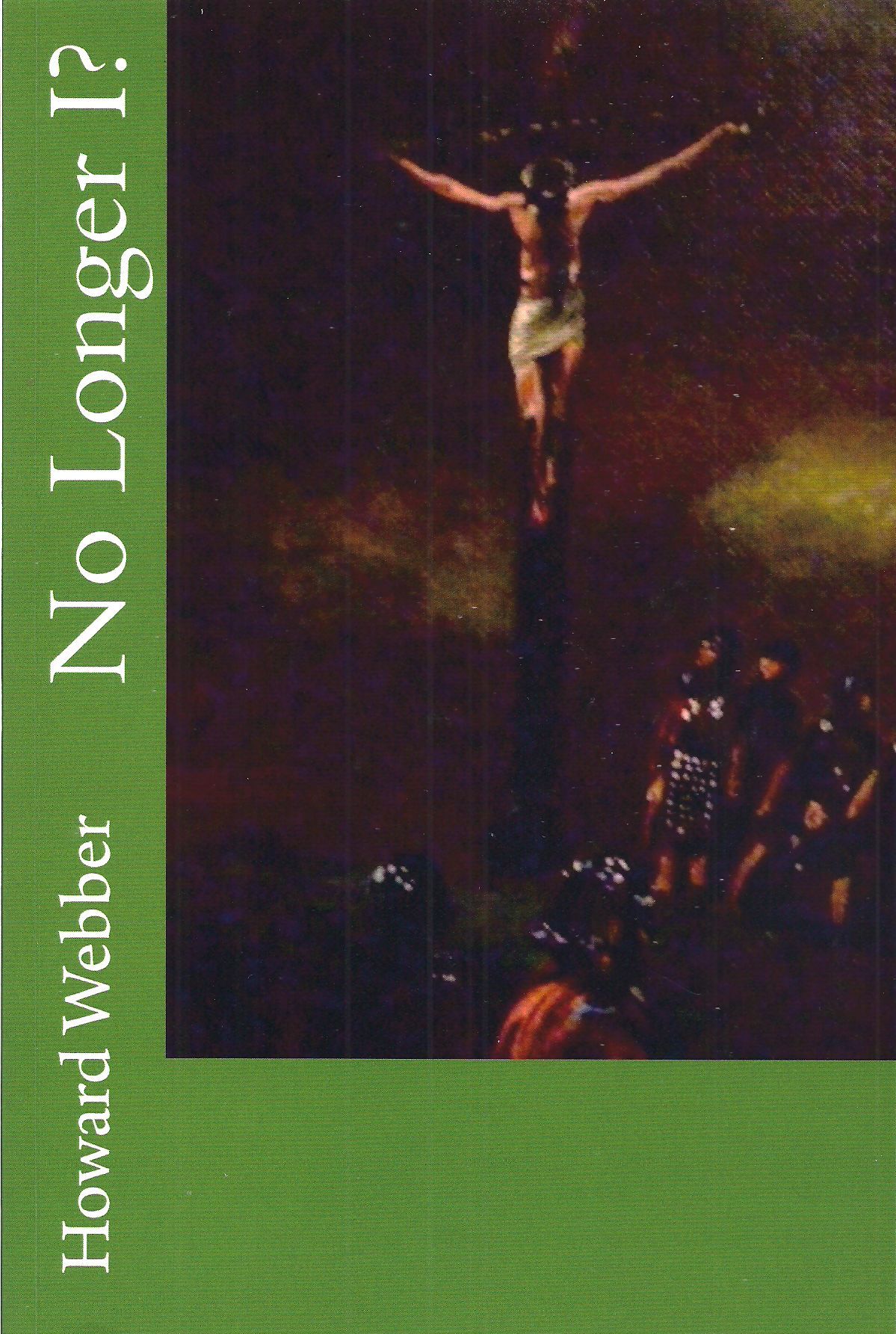
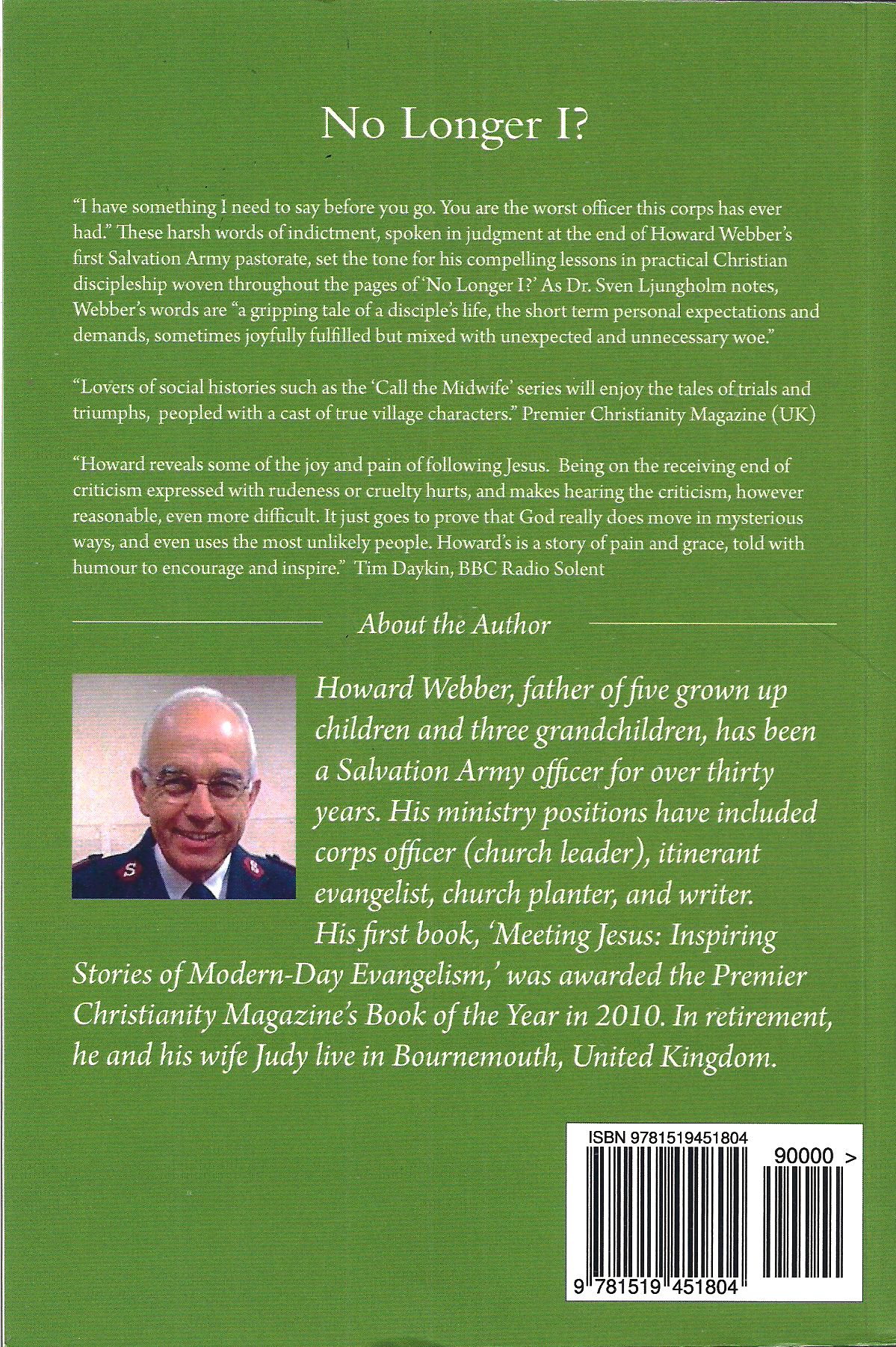
No Longer I? (Howard Webber)

No Longer I (Front)
No Longer I (Back)

I first met Howard Webber back in the 1970s while working in the Pathology Department of Northampton General Hospital and studying to become Medical Laboratory Scientific Officer. Howard was also in the same line of work and moved to Northampton to take up a position in the Biochemistry Department, the branch of pathology in which I had decided to specialise.

We soon realised that we were both Salvationists, and later discovered we also shared the call of God to change direction from our chosen careers to follow vocations as full-time Salvation Army Officers, ministers of religion appointed to corps (church) leadership or other areas of Christian ministry. We both took this step of faith independently, and the majority of both our working lives have been following this calling. Howard is now an officer in retirement like me.

The first part of Howard’s book ‘No Longer I?’ is a candid account of his rich and various experiences in corps life, along with his struggles in those situations (some intensely personal) and the eventual discovery of answers. The second part explores those issues in the light of scripture and is more devotional in style. Both parts work well together, as Howard describes and explores the ups and downs, the joys and the sorrows, on his own journey of faith. He tells it as it is, and I found his writing refreshingly open, honest and powerful.

Let me quote the opening paragraph: I have something I need to say before you go, ‘Miss Barrett called out as I closed the lounge door, so I opened it again and stepped back into the room. Following a brief preamble she got to the point of why she had called me back, ‘I need to tell you that you are the worst officer (minister) this corps (church) has ever had!’ Those harsh words of indictment, spoken in judgment at the end of his first appointment, set the tone for compelling lessons in practical Christian discipleship woven throughout the pages of the book.

This isn’t just a book for Salvationists, but one for anyone desiring to reach into the heart of Christian life and ministry.

Note: The title of the book comes from Paul’s Letter to the Galatians: I have been crucified with Christ; it is no longer I who live, but Christ who lives in me; and the life I now live in the flesh I live by faith in the Son of God, who loved me and gave himself for me. (Galatians 2:20 RSV)

Uplifting Faith (Isaiah 46)

Isaiah 46 contains two sharply contrasting pictures; the first is of people carrying their god, the second one is of God carrying his people.

Isaiah can’t help smiling when he sees the shallow religion of the nations around Israel, what a miserable thing it must be to have a god who is a burden, who must be carried from place to place. So, he draws a humorous picture of a glittering god that looks great, but needs half a dozen men to carry it, a useless burden that weighs them down.

The second picture is of God our Heavenly Father, who carries his people from before birth, through life and past death into eternity.

Read: Isaiah 40:28-31

These two pictures represent two types of religion. On the one hand, one that must be carried, that’s a burden, that’s a duty, which weighs us down and wears us out. On the other hand, one that worships a God who upholds with his powerful arms, one that carries us, lifts us, lightens our spirits, and fills us with peace and joy.

I know which religion I prefer! Unfortunately, there are some Christians who choose the heavy, burdensome religion. Is it any wonder people reject it?

The disciples who met the Risen Jesus on the Emmaus Road recognised him when he broke bread. Their spirits were lifted: Were not our hearts burning within us while he talked with us on the road and opened the Scriptures to us? Luke 24:32

Commissioner Catherine Bramwell-Booth wrote:
Come, blessed Jesus, come;
Break bread again for me;
Lord open Thou my eyes that I
Thy living self may see.
Then joy shall fill my heart,
My strength be all renewed
To witness of Thy death and life,
By Thine own power endued.

As we open ourselves up to God our Heavenly Father, and as we come humbly into his presence, he lifts us up and fills us with his nature.

Let’s not be content with a religion of strain and struggle, fear and duty, heavy hearts, and clouded faces, when we can have a faith that carries our burdens, lightens our spirits, and fills us with love, joy, and peace.

True faith is attractive, it draws others to Christ. May we never turn anyone away because our religion is joyless, judgemental, and narrow. 1 John 5:3-4

Jesus condemned the religious leaders of his day because of the heavy loads they put on the people. Matthew 23:1-4

How refreshing, then, are the words of Jesus: Come to me, all you who are weary and burdened, and I will give you rest. Take my yoke upon you and learn from me, for I am gentle and humble in heart, and you will find rest for your souls. For my yoke is easy and my burden is light. Matthew 11:28-30

May that be real in our lives, and may we share it with those around us, as we recognise the true nature of God our Heavenly Father.

A Focus on Forgiveness

In Matthew 18:21-35 the focus is on forgiveness, mercy, and the importance of compassion in interpersonal relationships.

The disciple Peter approaches Jesus with a question: “Lord, how often shall my brother sin against me, and I forgive him? Up to seven times?” Peter’s question reflects the common rabbinic teaching of the time, which suggested forgiving someone up to three times. Peter, perhaps seeking to show great magnanimity, suggests forgiving up to seven times, thinking he is being generous.

Jesus responds with a profound lesson on forgiveness, saying, “I do not say to you, up to seven times, but up to seventy times seven.” This statement is not meant to be taken literally, but rather emphasises limitless forgiveness. Jesus is teaching that forgiveness shouldn’t be constrained by a specific number but should be extended generously and without bounds.

To illustrate this point further, Jesus tells a parable about a king who wished to settle accounts with his servants. In this parable, the king represents God, and the servants symbolise humanity. One servant owes the king an enormous debt, an amount so vast that he could never hope to repay it. The servant pleads for mercy and time to repay the debt. Astonishingly, the king, moved by compassion, forgives the entire debt, cancelling it completely.

However, the forgiven servant encounters another servant who owes him a relatively small sum of money. Instead of showing the same compassion he received, the forgiven servant seizes his fellow servant and demands payment. When the fellow servant begs for mercy and time to repay, the forgiven servant refuses and has him thrown into prison.

Upon hearing of this, the king is furious. He calls the forgiven servant back and chastises him for not showing the same mercy he had received. The king then has the unforgiving servant thrown into prison until he can repay the massive debt he owed.

The parable concludes with Jesus delivering a powerful message: “So also my heavenly Father will do to every one of you if you do not forgive your brother from your heart.” This message underscores the importance of forgiveness in the Christian faith. Just as God forgives our sins, Christians are called to extend forgiveness to others.

This passage is a cornerstone of Christian ethics, teaching believers to forgive as they have been forgiven by God and to approach forgiveness with a generous and compassionate heart.

The Urgency of Love

Romans 13:8-14 addresses the concept of love, obedience to authority, and living in the light of Christ’s coming

The Apostle Paul imparts important teachings to the early Christin community in Rome. He begins with a powerful statement: “Owe no one anything except to love one another.” Here, Paul emphasizes the significance of love as the only debt Christians should have. Love, in the context of this passage, refers to the selfless, agape love that mirrors God’s love for humankind.

Paul then continues to emphasize the importance of fulfilling the commandments, particularly “You shall not commit adultery, you shall not murder, you shall not steal, you shall not covet,” and other commandments: all summed up in the love for one’s neighbour as oneself. He emphasizes that love is the fulfilment of the law, emphasizing that if one loves their neighbour, they won’t harm or wrong them.

The passage also touches on the idea of obedience to authority. Paul encourages believers to submit to governing authorities, as God has established these authorities to maintain order and justice in society. This aligns with the broader biblical theme of respecting earthly authorities while prioritising obedience to God’s ultimate authority.

Paul then shifts the focus to the urgency of the times, suggesting that the return of Jesus Christ is imminent. He calls on believers to live as if they are in the light of Christ, casting off the works of darkness and putting on the armour of light. This means leading lives characterized by righteousness and holiness, free from sinful behaviour and debauchery.

He advises believers to walk properly, as in the daytime, avoiding revelry, drunkenness, sexual immorality, and quarrelling. Instead, they should “put on the Lord Jesus Christ” and make no provision for the flesh, which implies that they should be spiritually vigilant and not give in to sinful desires.

This passage underscores the importance of love, both in interpersonal relationships and in fulfilling the commandments of God. It also emphasizes obedience to earthly authorities and the need to live a life of righteousness and holiness in anticipation of Christ’s return. It serves as a reminder to Christians of their responsibilities in the world and their hope in the future redemption through Jesus Christ.