Israel-Palestine Conflict Overview

The Israel-Palestine conflict, one of the most protracted and deeply entrenched disputes in the world, revolves around historical claims to land, national identity, and sovereignty in the Middle East. It’s a complex and multifaceted issue with roots dating back to the late 19th and early 20th centuries.

At the heart of this conflict is the clash between Jewish Zionists and Arab Palestinians over territory, primarily the land that now comprises Israel, the West Bank, and the Gaza Strip. The Zionist movement emerged in the late 19th century, aiming to establish a Jewish homeland in Palestine, which was then part of the Ottoman Empire. The migration of Jewish immigrants into Palestine, primarily in the early 20th century, resulted in increasing tensions between the Jewish and Arab communities.

The situation escalated in the aftermath of World War II and the Holocaust, prompting international sympathy and support for Jewish survivors and the Zionist cause. In 1947, the United Nations proposed a partition plan, dividing Palestine into separate Jewish and Arab states, with Jerusalem designated as an international city. The plan was accepted by the Jewish leadership but rejected by the Arab states and Palestinian leadership.

In 1948, following the declaration of the State of Israel, the Arab-Israeli War broke out. Israel emerged victorious and expanded its territory beyond the UN-allocated borders. This led to the displacement of hundreds of thousands of Palestinian Arabs, creating a refugee crisis that remains unresolved to this day.

Subsequent conflicts, most notably the Six-Day War in 1967, further reshaped the territorial landscape, with Israel capturing the West Bank, Gaza Strip, Sinai Peninsula, and the Golan Heights. The occupation of these territories has been a central point of contention in the conflict.

Core issues in the Israel-Palestine conflict include:

Jerusalem: Both Israelis and Palestinians claim Jerusalem as their capital, with the city holding deep religious significance for Jews, Muslims, and Christians. The status of Jerusalem remains a major obstacle to a comprehensive peace agreement.

Borders: The borders of a future Palestinian state and the security concerns of Israel are fundamental issues. Palestinians seek a state based on pre-1967 borders, while Israel emphasizes the need for secure borders.

Refugees: The Palestinian refugee issue is a matter of great importance. Millions of Palestinians are descendants of those who were displaced during the 1948 and 1967 conflicts. They demand the right of return or compensation, while Israel is concerned about the demographic implications of such a return.

Security: Ensuring the security of Israel and its citizens has been a paramount concern, given historical conflicts and acts of violence. The demilitarization of a future Palestinian state and other security arrangements are central to negotiations.

Efforts to resolve the Israel-Palestine conflict have involved various peace negotiations, international initiatives, and accords. The Oslo Accords of the 1990s aimed at a two-state solution, where Israel and Palestine would coexist peacefully side by side. However, the implementation of these agreements faced numerous obstacles, including violence and political disputes.

The situation on the ground remains tense, marked by recurring violence, settlement expansion in the West Bank, and restrictions on the movement of Palestinians. International involvement, including mediation by the United States, the United Nations, and regional actors, continues in attempts to reach a comprehensive and lasting resolution to the conflict.

The Israel-Palestine conflict has significant regional and global implications, impacting stability in the Middle East and international diplomacy. Finding a just and sustainable solution remains a formidable challenge, with the hope that a negotiated settlement can eventually bring about a peaceful coexistence between Israelis and Palestinians.

Souter Lighthouse

During the school summer holiday in 2023, we visited Souter Lighthouse on the rugged coastline of South Tyneside, it stands as a striking sentinel of maritime history and engineering prowess. Completed in 1871, this iconic structure holds the distinction of being the first lighthouse in the world to be designed and built specifically to use alternating electric current, thanks to its visionary creator, Sir Thomas Matthews.

Souter Lighthouse’s unique octagonal design, crafted from bricks and surrounded by picturesque red and white stripes, immediately captures the attention of visitors. Rising to a height of 23 meters (75 feet), its light, visible from 26 miles away, played a crucial role in guiding ships safely through treacherous waters. The lighthouse’s lamp, initially powered by carbon arc lamps and later upgraded to more modern equipment, helped mariners navigate the perilous North Sea coastline.

Beyond its navigational significance, Souter Lighthouse has evolved into a cultural and historical treasure. The site features a visitor centre where guests can explore the lighthouse’s fascinating history and its impact on the maritime world. The charming coastal landscape surrounding Souter also beckons hikers and nature enthusiasts to explore its scenic beauty.

In 1988, Souter Lighthouse was decommissioned and is no longer an active aid to navigation, but it continues to stand as a symbol of maritime heritage. Its status as a Grade II listed building ensures its preservation for future generations to appreciate.

Breathe: Breathing Exercises

Sadly, anxiety, depression, and other mental health pressures are constant companions in the modern world, and no one is immune from these unwelcome visitors. So, anything that can boost our mood is welcome.

Breathe is a free Android app (with no adverts) that I find beneficial. Breathing exercises are a helpful way of relieving anxiety and stress, and this app helps you tackle them. The app is great for keeping calm and promoting sleep and provides daily reminders and encouragement for hitting monthly goals and the like.

If you like the app there’s an option to support its development with affordable ranges of one-off payments or a monthly subscription.

Simplenote: Simple Publishing

Simplenote is a cross-platform app/website that has one feature that is especially useful. You can use it to publish a page on the web with a simple click, share the link with your audience, and remove the page just as easily at any time. But it’s far more than that and can be used for a variety of purposes.

Notes stay updated across all your devices, automatically and in real time. There’s no “sync” button: It just works. Add tags to find notes quickly with instant searching. Share a to-do list, post some instructions, or publish your notes online. Notes are backed up with every change, so you can see what you noted last week or last month. Write, preview, and publish your notes in Markdown format. Apps, backups, syncing, sharing – it’s all completely free. Source

If you’re not using Simplenote, you’re missing out. TechCrunch

But that’s not fair!

But that’s not fair! We’ve all heard the phrase (especially if we have children) and probably used it ourselves sometimes. Jesus uses a parable to challenge our concept of fairness and illustrate the generosity of God.

Matthew 20:1-16 is a well-known passage often referred to as the ‘Parable of the Workers in the Vineyard’. It’s a human story about workers’ wages and a spiritual message about the generosity of God’s grace.

Jesus begins by describing a landowner who went out early in the morning to hire labourers for his vineyard. He agreed to pay them a denarius, a typical day’s wage, for their work. Later in the day, at the third, sixth, ninth, and even eleventh hours, he hired more labourers, promising to pay them “whatever is right.”

As the day ended, the landowner instructed his supervisor to pay the labourers, beginning with those who were hired last and ending with those who were hired first. To the surprise of those who worked all day, each group received a denarius, regardless of the hours they’d worked. Those who’d worked all day grumbled, thinking they would receive more. However, the landowner responded, “Friend, I am doing you no wrong. Did you not agree with me for a denarius? Take what belongs to you and go. I choose to give to this last worker as I give to you. Am I not allowed to do what I choose with what belongs to me? Or do you begrudge my generosity?”

The landowner symbolises God, who’s generous and just. He shows that God’s grace is abundant and not dependent on our efforts or time of entry into faith. God’s love and salvation are freely given to all who believe, regardless of their past or how late they come to faith.

The denarius represents salvation, which is equally available to everyone, regardless of their past sins or circumstances. This parable emphasises that all believers are equal in God’s eyes.

The grumbling of the labourers who worked all day illustrates how we often expect to be rewarded based on our efforts. However, God’s grace does not operate on a merit-based system; it’s given freely.

The labourers who grumbled were reminded of their initial agreement with the landowner. This teaches humility, reminding us that we shouldn’t compare our faith journey or blessings to others but should focus on our relationship with God.

In a broader theological context, this parable addresses the concept of salvation by grace through faith. It emphasises that salvation cannot be earned through works alone but is a gift from God. It challenges the human tendency to judge others based on their perceived worthiness and calls for a spirit of humility and gratitude.

Matthew 20:1-16 is a profound passage that teaches about the generosity of God’s grace, equality in his kingdom, the contrast between human expectations and divine grace, and the importance of humility in our faith journey. It encourages us to appreciate God’s unmerited favour and reminds us that his love and salvation are available to all who believe, regardless of their past or when they come to faith.

The Race of Faith (John Clifton)

I’m pleased to share this post by fellow Salvation Army Officer John Clifton…

Following a training programme is crucial to being able to complete any physical event. Towards the end of 2022, I signed up to do an iron-distance triathlon. Knowing I couldn’t just turn up and complete it on the day, I followed, in a manner that could be called ‘religious’, the ‘Be Iron Fit’ programme by Don Fink. It is a 30-week programme that, starting on January 1st, 2023, meant that the event day landed perfectly on July 30th, the race day for Outlaw Nottingham Full. The format of the programme is clearly structured. Monday is rest day (there was an addictive dopamine-rush of achievement from ticking off completion of the first training session on January 1 – a Monday!); Tuesday was swim and run; Wednesday was the brick session (google it); Thursday was swim and cycle; Friday was run (then also swim at a later phase of the programme); Saturday was a long cycle (then followed by a short run brick session; again, google it) and then Sunday was a short cycle and a longer run (not back-to-back, so not a ‘brick’… Ok, here you go…).

Click here to read the full article.

Silent Joy in Grief

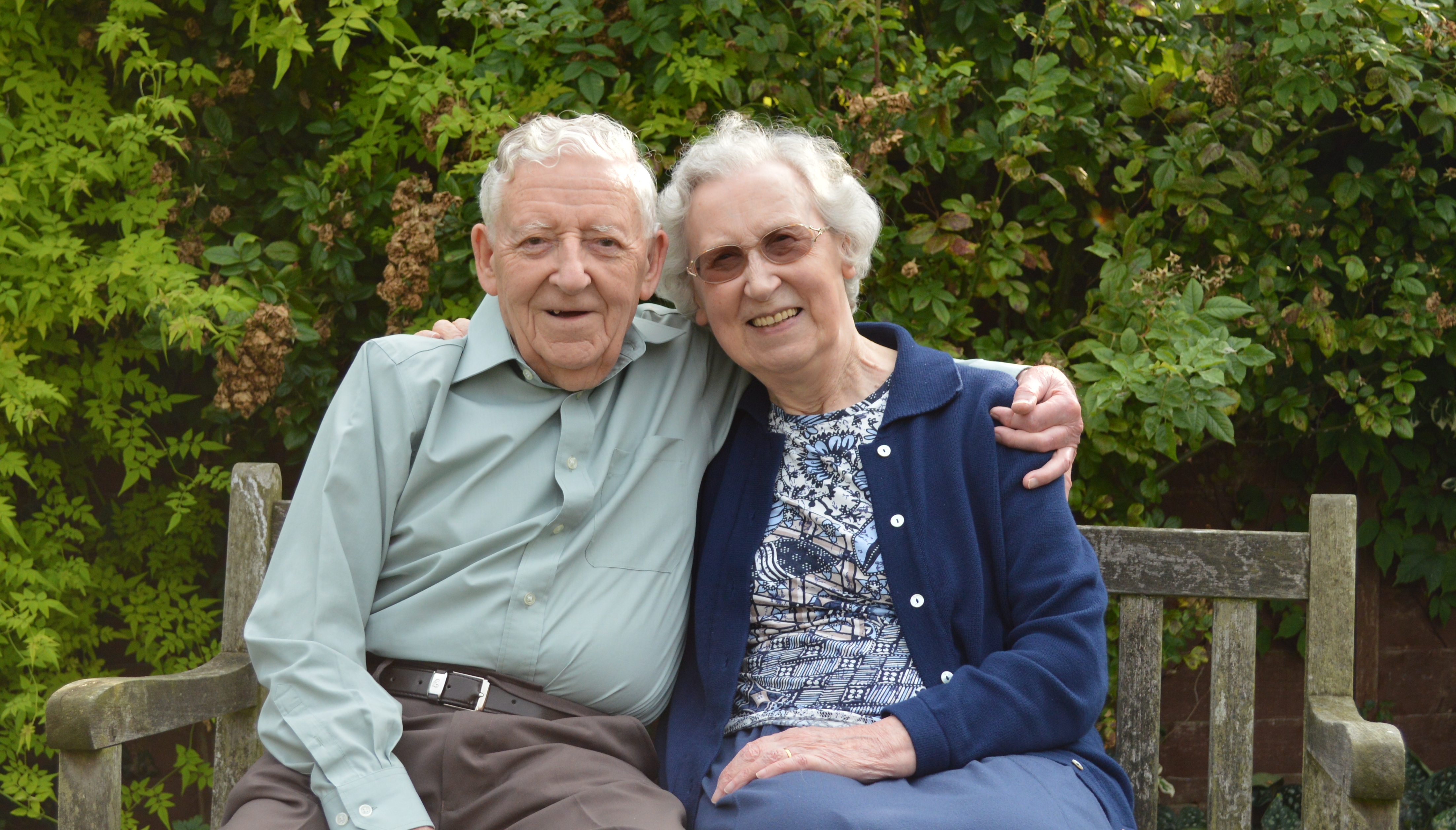
130824 Mum & Dad

My father (Fred) died on Wednesday 2 October 2013 at the age of 89, and my mother (Jean) on Sunday 26 May 2019 at the age of 94.

Special days and anniversaries still awaken powerful emotions which lie barely below the surface of my day-to-day life, along with the ongoing emptiness of loss. Additionally, this is combined with the strange feeling of ‘lostness’ that occurs after the death of both parents, a feeling which may be magnified for me because I’m an only child of only children.

I had the following words of Dietrich Bonhoeffer printed on the back of the order of service for both their funerals as they expressed something my family wanted to articulate. These words have become even more meaningful to me with the passing of time, and I hope you find them helpful as well.

There is nothing that can replace the absence of someone dear to us, and one should not even attempt to do so. One must simply hold out and endure it. At first that sounds very hard, but at the same time it is also a great comfort. For to the extent the emptiness truly remains unfilled one remains connected to the other person through it. It is wrong to say that God fills the emptiness. God in no way fills it but much more leaves it precisely unfilled and thus helps us preserve, even in pain, the authentic relationship. Further more, the more beautiful and full the remembrances, the more difficult the separation. But gratitude transforms the torment of memory into silent joy. One bears what was lovely in the past not as a thorn but as a precious gift deep within, a hidden treasure of which one can always be certain.

No Longer I? (Howard Webber)

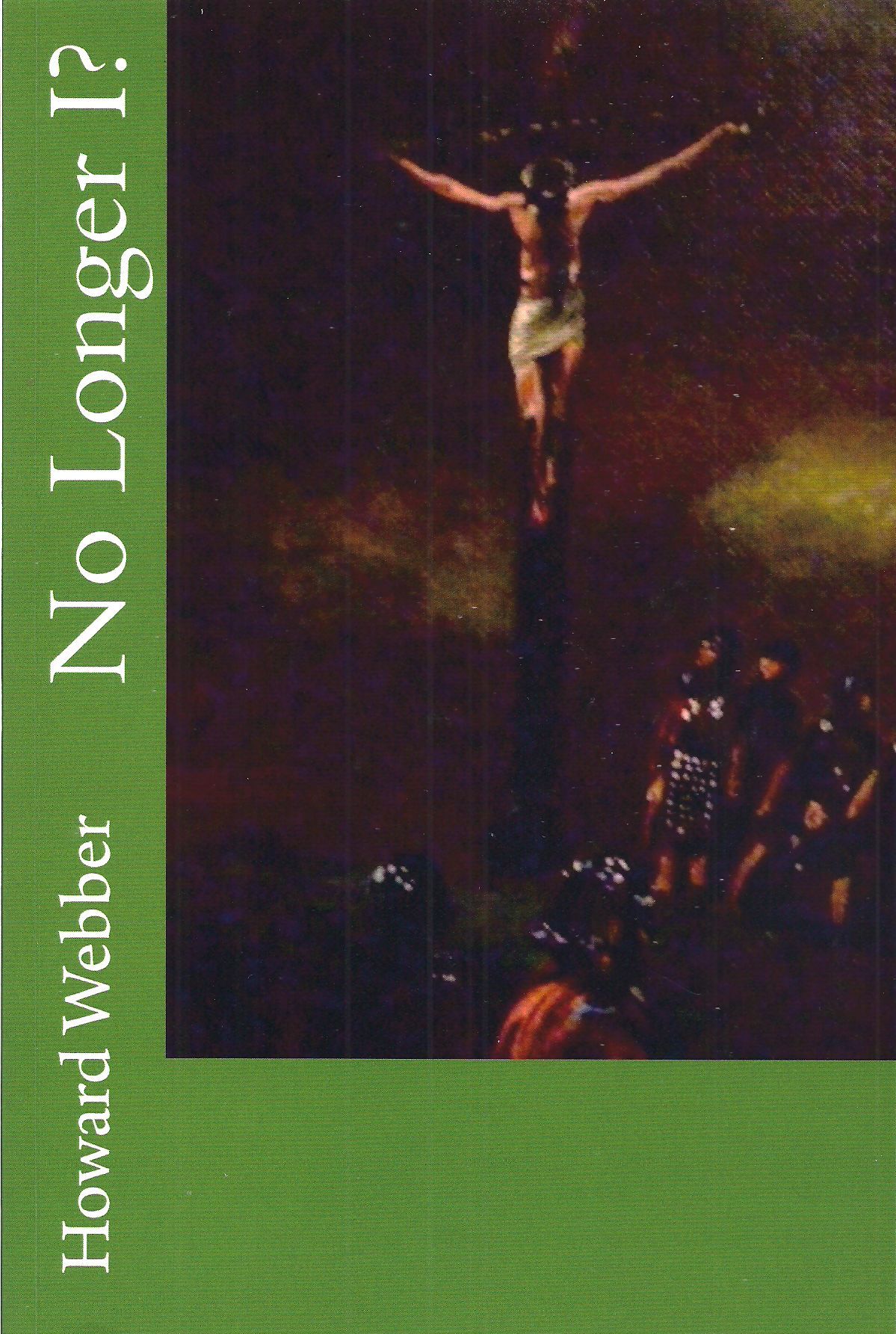
No Longer I (Front)
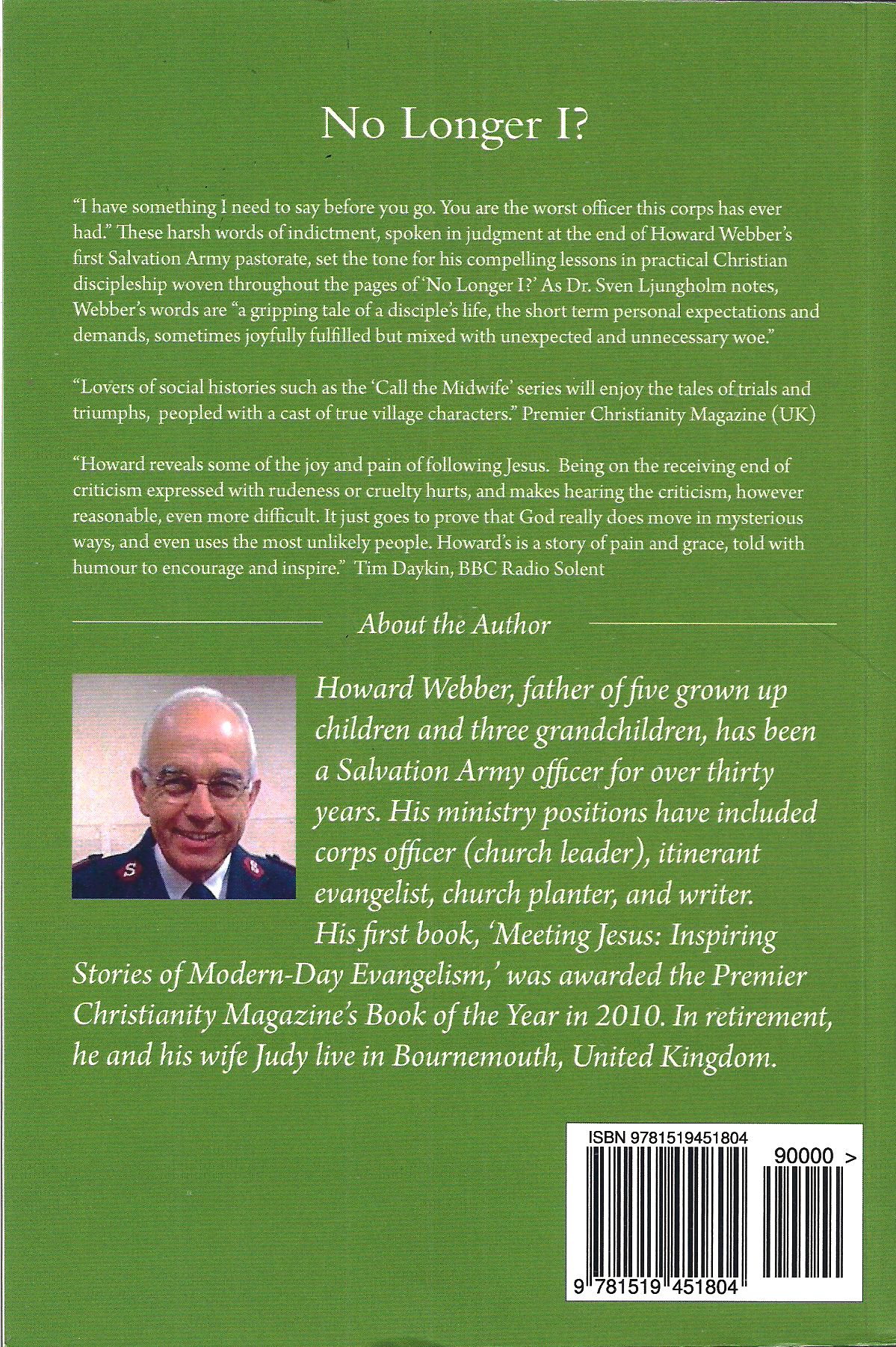
No Longer I (Back)

I first met Howard Webber back in the 1970s while working in the Pathology Department of Northampton General Hospital and studying to become Medical Laboratory Scientific Officer. Howard was also in the same line of work and moved to Northampton to take up a position in the Biochemistry Department, the branch of pathology in which I had decided to specialise.

We soon realised that we were both Salvationists, and later discovered we also shared the call of God to change direction from our chosen careers to follow vocations as full-time Salvation Army Officers, ministers of religion appointed to corps (church) leadership or other areas of Christian ministry. We both took this step of faith independently, and the majority of both our working lives have been following this calling. Howard is now an officer in retirement like me.

The first part of Howard’s book ‘No Longer I?’ is a candid account of his rich and various experiences in corps life, along with his struggles in those situations (some intensely personal) and the eventual discovery of answers. The second part explores those issues in the light of scripture and is more devotional in style. Both parts work well together, as Howard describes and explores the ups and downs, the joys and the sorrows, on his own journey of faith. He tells it as it is, and I found his writing refreshingly open, honest and powerful.

Let me quote the opening paragraph: I have something I need to say before you go, ‘Miss Barrett called out as I closed the lounge door, so I opened it again and stepped back into the room. Following a brief preamble she got to the point of why she had called me back, ‘I need to tell you that you are the worst officer (minister) this corps (church) has ever had!’ Those harsh words of indictment, spoken in judgment at the end of his first appointment, set the tone for compelling lessons in practical Christian discipleship woven throughout the pages of the book.

This isn’t just a book for Salvationists, but one for anyone desiring to reach into the heart of Christian life and ministry.

Note: The title of the book comes from Paul’s Letter to the Galatians: I have been crucified with Christ; it is no longer I who live, but Christ who lives in me; and the life I now live in the flesh I live by faith in the Son of God, who loved me and gave himself for me. (Galatians 2:20 RSV)

Binsey Poplars

This poem was written in 1879 by Gerard Manley Hopkins in response to the felling of a row of poplar trees, I share it here after the felling of the iconic sycamore tree at Sycamore Gap in Northumberland.

My aspens dear, whose airy cages quelled,
Quelled or quenched in leaves the leaping sun,
All felled, felled, are all felled;
    Of a fresh and following folded rank
            Not spared, not one
            That dandled a sandalled
            Shadow that swam or sank
On meadow and river and wind-wandering weed-winding bank.
 
O if we but knew what we do
            When we delve or hew—
    Hack and rack the growing green!
            Since country is so tender
    To touch, her being so slender,
    That, like this sleek and seeing ball
    But a prick will make no eye at all,
            Where we, even where we mean
            To mend her we end her,
            When we hew or delve:
After-comers cannot guess the beauty been.
    Ten or twelve, only ten or twelve
            Strokes of havoc unselve
            The sweet especial scene,
            Rural scene, a rural scene,
            Sweet especial rural scene.

Gerard Manley Hopkins (1844–1889)

I’m not retiring from running!

I’ve been a runner on and off over the years, but never as seriously as in the last ten years. I used to run at school, and I especially remember running along the beach when I lived in Filey on the North Yorkshire coast. My decision to take it up again in 2013 was prompted by a desire to raise money for the Salvation Army’s Annual Appeal, as well as the need for a significant challenge to get fit.

So, not having run for many years, I entered the Middlesbrough 10K road race (that’s 6.2 miles). But, after my first training run round the block, I seriously wondered what I’d let myself in for. This was going to be a challenge in my late fifties. In the end though, I ran it twice with both times under an hour.

Now, in my late sixties, I don’t want my young children to see me as an old father, rather as a fit and active dad who’s fun to be with. So, I regularly run 5k parkruns, even if nowhere near my personal best of 25:03 set in 2014 when I was fifty-nine.

Advancing years are working against me, but I’ve currently got no plans to retire from running!