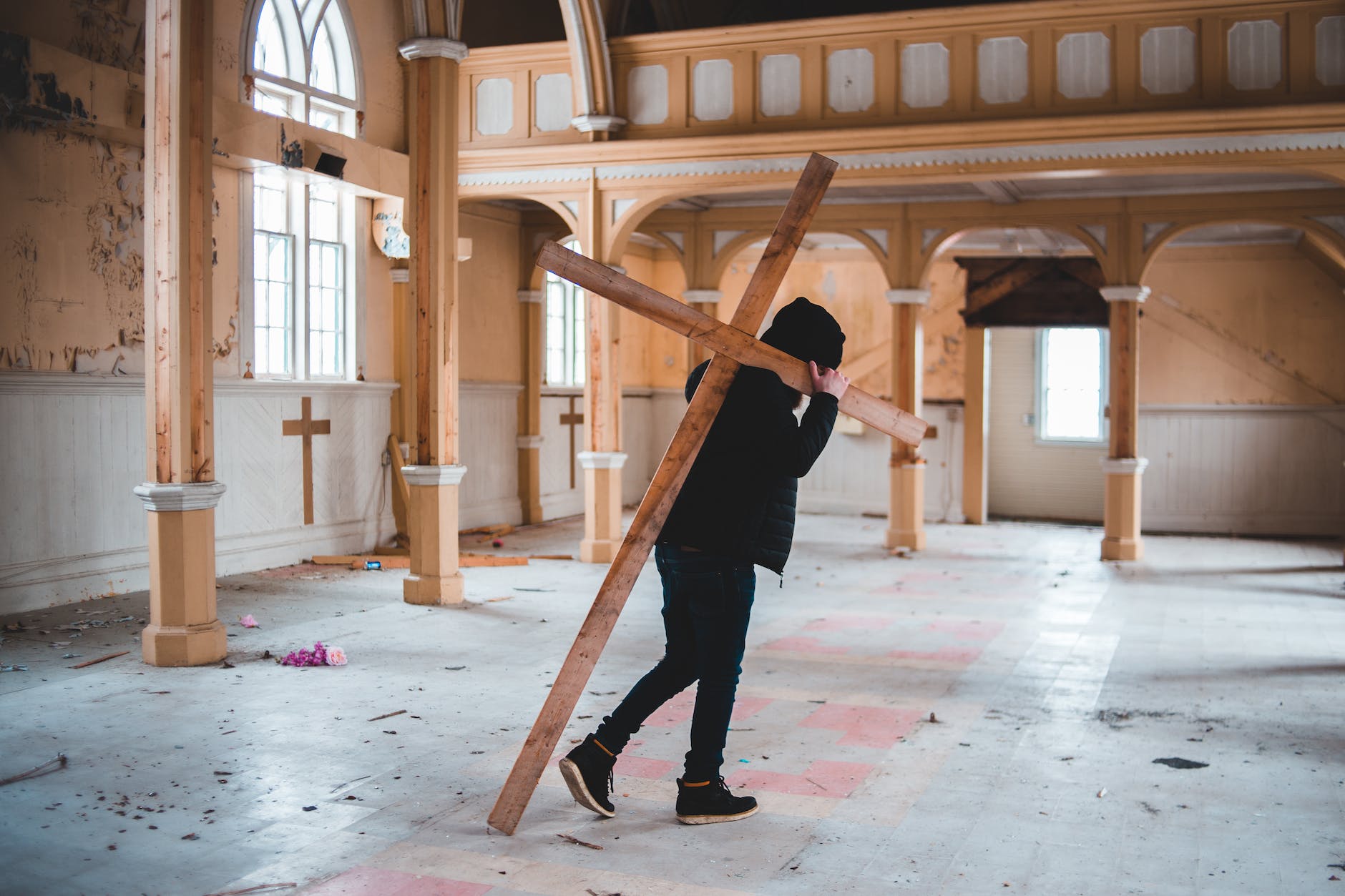
Misunderstanding Palm Sunday

It’s exciting to be in a crowd, but it can also be very frightening. The mood of a crowd can rapidly change, the dynamic of the mob can quickly take over. Who knows what the crowd will do next, especially if its expectations are not met?

The crowds surrounding Jesus as he rode into Jerusalem were no different. The emotions and excitement were reaching fever pitch, and the conditions were right for the whole thing to turn nasty.

You can read the story of the first Palm Sunday in Luke 19:28-44.

There would have been thousands of hot, excited, sweaty people all wanting to see Jesus; all wanting to know who he was, all wanting to see what he would do.

Jesus approaches and enters Jerusalem in the full knowledge that both the religious and political leaders were feeling threatened by his teaching and ministry, and that the crowd could easily turn if he didn’t fulfil their expectations and hopes.

The first Palm Sunday was a dramatic and hugely significant day in the life and ministry of Jesus. Prior to this, Jesus had resolutely set his face towards Jerusalem, to very publicly announce the coming of his kingdom.

He carefully chose a time when the people would be gathered in Jerusalem, and he chose a way of proclaiming his kingdom that was unmistakable.

But, as Jesus approached Jerusalem, he wept over it:
If you, even you, had only recognised on this day the things that make for peace! But now they are hidden from your eyes.

These weren’t the words of a human king, but rather the words of divine Saviour whose heart broke because of the spiritual and moral blindness of the people. He’d come to bring true peace, but they didn’t want it.

The crowd in Jerusalem thought they understood as they cheered, shouted, waved, and threw palm branches, but completely misunderstood Jesus’ identity.

They were full of nationalistic fervour and failed to recognise the true nature of Jesus’ kingship. Palms had been a symbol of Jewish nationalism from the time of the Maccabees and appeared on Jewish coins during their revolutionary struggle against the Romans, and now they were oppressed by them.

Jesus showed the people his true identity by riding on a donkey; a sign, according to the Old Testament, of the Messiah coming in peace. The people expected the Messiah to bring victory by force, but Jesus came to conquer by the Cross. The way of Jesus is not one of hatred, force or violence, rather it’s the way of sacrificial love.

The praise and adulation of the crowd was not the glory Jesus wanted, his glory was to come through self-sacrifice and suffering.

On this Palm Sunday, may we make our own decision to set our face towards Jerusalem; resolving to go God’s way, despite the expectations of the crowds, and live like Jesus.


Palm Sunday 2024 (Óscar Romero)

Palm Sunday this year falls on the day we remember Óscar Romero, the Archbishop of San Salvador who championed the cause of the poor and marginalised. He was assassinated on Monday, 24 March 1980, at the age of 62.

So, instead of concentrating on the events of the first Palm Sunday, I’d like to celebrate Óscar Romero and learn from the life of this extraordinary man, a hero of faith, prayer, and justice.

Óscar Romero was the Archbishop of San Salvador at a time of terrible violence and oppression during El Salvador’s civil war. He was a contemplative and conservative man, but a fierce opponent of economic inequality and of the kidnapping, torture, and murder of his people.

He became a beacon of hope for the poor. Although his killers were never identified, it’s almost certain that Romero’s very public stand against the injustice of the military government was the reason he was shot dead as he celebrated Mass.

Romero saw that love can’t be theoretical, neither is it soft or weak, but there is a violence to love. Not a violence that hurts people, but a violence that resists anything that harms people. It stands up to the powers that exploit and destroy others; it’s this kind of love that Jesus demonstrated on the cross.

Read: Philippians 2:5-11 (one of the Lectionary Bible readings for today).

Óscar Romero wrote: “All of us, if we really want to know the meaning of conversion and of faith and confidence in another, must become poor, or at least make the cause of the poor our own inner motivation. That is when one begins to experience faith and conversion: when one has the heart of the poor, when one knows that financial capital, political influence, and power are worthless, and that without God we are nothing. To feel that need of God is faith and conversion.”

“The violence we preach is not the violence of the sword, the violence of hatred. It is the violence of love, of brotherhood, the violence that wills to beat weapons into sickles for work.”

On this Palm Sunday, let’s reflect on the life of Óscar Romero and consider how he followed Jesus, the one who rode into Jerusalem as the Prince of Peace.

St. Patrick’s Day

St. Patrick’s Day, which falls on 17th March, is all about celebrating the legendary patron saint of Ireland, St. Patrick. He was actually born in Roman Britain way back in the late 4th century. He was kidnapped when he was just 16 and taken to Ireland to work as a slave, but he managed to escape. He later returned to Ireland around 432 CE with a mission, to convert the Irish to Christianity. He used a humble shamrock to explain the Holy Trinity, which eventually became a symbol of this day.

For over a thousand years, the Irish have been celebrating this day, sticking to their traditions. They usually start with a morning church service and then dive into festivities in the afternoon, especially since it falls during Lent when the rules about meat-eating get relaxed a bit. That means it’s time for some serious feasting on Irish classics like bacon and cabbage.

Interestingly, the first-ever St. Patrick’s Day parade didn’t happen in Ireland, but in America! Back in 1601, in a Spanish colony that’s now St. Augustine, Florida. And then in 1772, Irish soldiers in the English military based in New York City decided to honour St. Patrick with their own parade. Over the years, these parades became a big deal, showing off Irish pride among immigrants in America.

Fast forward to today, and St. Patrick’s Day is all about parades, wearing anything and everything green, and of course, indulging in delicious Irish food and drinks. It’s a massive celebration, not just in Ireland but all over the globe, especially in places with lots of Irish folks. But beyond the fun, it’s also a time to think about Irish heritage and culture.

Sure, over time, the day’s meaning might have shifted a bit, but it’s still all about honouring those Irish traditions and remembering the work St. Patrick did in spreading Christianity. Yeah, some people might grumble about how commercialised it’s become or how it sometimes plays into stereotypes, but for many, it’s a day of cultural pride and religious reflection, a reminder of the incredible legacy left by Ireland’s favourite saint.

The Fifth Sunday of Lent

Following on from last Sunday we again turn to John’s Gospel, to a passage that captures a pivotal moment in the life of Jesus, where the narrative shifts towards his impending crucifixion. John 12:20-33 (click on link) is rich with symbolism and theological significance, marking the beginning of the end of Jesus’ earthly ministry.

The passage begins with some Greeks, most likely Jewish diaspora, expressing their desire to see Jesus during the Passover festival. Their request is significant as it symbolises the reach of Jesus’ message beyond the Jewish community to the wider world. This event triggers Jesus to declare that “the hour has come for the Son of Man to be glorified” (John 12:23), indicating his awareness of the approaching sacrifice he’s about to make.

Jesus uses the metaphor of a grain of wheat to explain the necessity of his death; unless a grain of wheat falls to the ground and dies, it remains a single seed, but if it dies, it produces many seeds (John 12:24). This analogy illustrates the paradoxical nature of life and death in the Christian faith, where through death comes greater life and fruitfulness.

He then speaks of the cost of discipleship, urging his followers to love their life less than their devotion to him, promising that those who serve him must follow him, and in doing so, the Father (John 12:25-26) will honour them. This teaching emphasises the idea of self-denial and the pursuit of eternal life over temporary worldly pleasures.

As Jesus contemplates his death, he admits to being troubled, but resolves that it’s for this purpose he’s come to this hour. He refuses to ask for deliverance from this hour, instead, he calls on God’s name to be glorified, to which a voice from heaven responds, affirming that it’s been glorified and will be glorified again (John 12:27-28). This divine interaction serves as a testament to Jesus’ obedience to God’s will and the divine plan of salvation.

Jesus explains that his crucifixion will serve as judgement on this world and will drive out Satan, the ruler of this world (John 12:31). He also prophesies that when he’s lifted up from the earth, he will draw all people to himself (John 12:32), alluding to his death on the cross and the universal salvation it offers.

The passage concludes with the crowd questioning Jesus about his statements, as they understood from Scripture that the Christ would remain forever. Jesus responds by urging them to walk in the light while they have it, to avoid being overtaken by darkness (John 12:34-36). This final exhortation serves as a call to faith and a warning of the consequences of rejecting the light, namely Jesus himself.

In summary, John 12:20-33 presents a profound theological discourse that sets the stage for the passion narrative. It highlights the global scope of Jesus’ mission, the sacrificial nature of his death, the call to discipleship, and the cosmic implications of the crucifixion. It’s a cornerstone for understanding the depth of Jesus’ teachings and the redemptive purpose of his death. May we seek to understand this better for ourselves, especially as we approach Palm Sunday and Holy Week.

A Brief History of Pi

Pi, denoted as π, is the mathematical constant representing the ratio of a circle’s circumference to its diameter. This transcendental number is approximately equal to 3.14159 and is crucial in various fields of science, mathematics, and engineering.

The quest to understand π has spanned several millennia. Ancient Babylonians and Egyptians used approximations of π for practical computations, with the Babylonians using a value of 3.125 and the Egyptians 3.1605. The first rigorous calculation of π was by Archimedes of Syracuse, who used the Pythagorean Theorem to approximate the area of a circle with polygons, deducing that π was between 3 1/7 and 3 10/71.

In the 5th Century, Chinese mathematician Zu Chongzhi calculated π to be 355/113, a remarkably accurate figure for the time. He achieved this by starting with a 24,576-sided polygon and performing extensive square root calculations.

The symbol π itself was introduced by Welsh mathematician William Jones in 1706 and later popularised by Swiss mathematician Leonhard Euler in 1737. The 18th Century saw further developments, such as Georges Buffon’s probability method to calculate π.

Modern computational power has allowed mathematicians to calculate π to trillions of digits. These efforts are not just for record-breaking but also test the limits of algorithms and computer hardware.

Pi Day, celebrated on March 14th (3/14), honours this enigmatic number. It’s a day for mathematical fun and education, reflecting on the significance of π and its place in the history of mathematics.

The Fourth Sunday of Lent

On the first three Sundays of Lent, we’ve been considering some noteworthy events in the life of Jesus. This Sunday we turn to John 3:14-21 which contains some of the most well-known verses in Christian theology, particularly regarding the concept of salvation and God’s love for humankind

In this passage, Jesus makes a reference to an incident from the Old Testament, specifically to when Moses lifted up the serpent in the wilderness. This event is recorded in Numbers 21:4-9, where the Israelites, plagued by venomous snakes, were instructed to look upon a bronze serpent raised on a pole by Moses, and those who looked upon it were saved from death. Jesus uses this historical event as an analogy for his own impending crucifixion. Just as the bronze serpent was lifted to save those who looked upon it, Jesus would be lifted on the cross to bring salvation to all who believe in him.

Verse 16 contains one the most famous and profound statement in the entire Bible: For God so loved the world that he gave his one and only Son, that whoever believes in him shall not perish but have eternal life. This verse encapsulates the essence of Christian faith, God’s immense love for humankind and his sacrificial gift of Jesus Christ to provide salvation and eternal life to those who believe in him.

The subsequent verses emphasise the purpose of Jesus’ coming into the world; not to condemn it, but to save it. However, it also highlights the human response to Jesus’ message; those who believe in him are not condemned, but those who do not believe stand condemned already because they have not believed in the name of God’s one and only Son.

The passage contrasts light and darkness, righteousness, and sin. Jesus is depicted as the light that has come into the world, but some people prefer darkness because their deeds are evil. This reflects the ongoing spiritual battle between good and evil, belief and unbelief, which is a recurring theme throughout the Gospel of John.

Furthermore, the passage stresses the importance of faith and belief in Jesus Christ as the Son of God. Belief in Jesus is not merely acknowledging his existence or his teachings but involves a deep, personal trust and surrender to him as Lord and Saviour. Those who believe in him are granted eternal life, while those who reject him face judgment.

Overall, John 3:14-21 presents a powerful message about God’s love, the purpose of Jesus’ incarnation, the necessity of faith, and the consequences of unbelief. It’s a foundational passage for Christian theology, encapsulating the core principles of salvation and redemption through Jesus Christ. The passage continues to inspire and challenge us to live lives of faith and obedience to the teachings of Jesus.

Don’t pay if it’s already yours!

You’d never keep paying for something you’d already paid for, or would you? Actually, lots of people do continue to pay for their smartphones even after they’ve been paid off in full.

For example, you take out a contract for two years and at the end of this period you’ve paid off the cost of the handset. But, unless you change the contract, your provider will continue to charge you for the phone.

For me, it was a simple process (involving just a few clicks) to switch to a SIM only contract and save myself money. Ask yourself, do I really need the latest handset?

The Third Sunday of Lent

In John 2:13-22, often referred to as the Cleansing of the Temple, Jesus enters the Temple in Jerusalem during the Passover feast and finds it filled with merchants selling animals for sacrifices and money changers exchanging currency. Seeing this commercial activity within the sacred space, Jesus becomes outraged, overturning the tables and driving out the sellers, declaring, “Take these things away; do not make my Father’s house a house of trade” (John 2:16).

This event serves as a powerful demonstration of Jesus’ authority and zeal for the sanctity of worship. By cleansing the temple, Jesus symbolically purges the corruption that had infiltrated the religious establishment. He challenges the exploitation of religious practices for profit and reaffirms the importance of reverence and purity in approaching God.

The reaction of the religious leaders is mixed. Some question Jesus, asking for a sign to justify his actions, while others, recognising the prophetic significance of his actions, demand an explanation for his authority. Jesus responds cryptically, saying, “Destroy this temple, and in three days I will raise it up” (John 2:19). Unaware that he speaks of his own Resurrection, they misunderstand his words, thinking he was referring to the physical temple.

This passage foreshadows Jesus’ ultimate mission and the significance of his Death and Resurrection. The Temple, a central symbol of Jewish worship and identity, becomes a metaphor for Jesus himself. Through his Death and Resurrection, Jesus inaugurates a New Covenant and becomes the ultimate place of encounter with God.

This incident demonstrates Jesus’ passionate response to the desecration of the Temple, highlighting his authority and commitment to true worship. It also lays the groundwork for understanding the deeper spiritual significance of his sacrificial Death and Resurrection.

As you reflect on this passage, what would Jesus be angry about today? What gets in the way of people approaching God in reverence and purity today?

February 29

Ever wondered why February gets an extra day every four years? Well, it’s all about keeping our clocks and calendars in sync with the Earth’s orbit around the sun. You see, our orbit takes approximately 365.2422 days, but the Gregorian calendar, which we use, only has 365 days. So, to make up for this discrepancy, we add leap years.

The idea of adding an extra day to February goes back to Julius Caesar’s time. Augustus Caesar later added two days to August, which caused February to lose out on its length.

Leap years happen every year that’s divisible by four, except for years divisible by one hundred but not by four hundred. This fine-tuning ensures our calendar stays accurate. The Gregorian calendar, introduced in 1582, made further adjustments by skipping three days every four hundred years. Additionally, leap seconds are occasionally added to align Earth’s rotation with atomic time and prevent drift.

Interestingly, leap years are also linked to the tradition of women proposing to men. This tradition stems from a 5th Century Irish legend involving St. Bridget and St. Patrick, and it gained popularity in Scotland in the 19th Century.

If you’re born on February 29, you’re called a leapling! In non-leap years, leaplings celebrate their birthdays on February 28 or March 1.

Popular culture has embraced leap years too. Works like Gilbert & Sullivan’s “Pirates of Penzance” and the film “Leap Year” explore leap year themes. While there’s no specific leap year cuisine, dishes like frogs’ legs and recipes involving the number four are often associated with leap year traditions.

Anthony, Texas, proudly calls itself the Leap Year Capital of the World and hosts a four-day festival every leap year. Superstitions about leap years are reflected in proverbs from various cultures, and some believe leap years bring bad luck for marriages.

Fun fact: Rare Disease Day is observed on February 29.

In conclusion, leap years play a crucial role in keeping our calendars accurate, and they’re woven into various cultural traditions and beliefs. So, every four years, let’s celebrate that extra day in February!

The Second Sunday of Lent

On this Second Sunday of Lent, we consider the moment when Jesus initiated a profound shift in his ministry by speaking openly to the disciples about his impending suffering, death, and resurrection. This moment set the stage for the climax of his earthly mission and underscored the sacrificial nature of his purpose on earth. See Mark 8:31-38 (click on link).

By foretelling his fate, Jesus demonstrated his awareness of God’s plan for redemption and the necessity of his sacrificial death to fulfil that plan.

When Peter reacts with disbelief and attempts to dissuade Jesus from such a fate, Jesus rebukes him sternly, recognising that Peter’s perspective aligns more with human concerns than divine purposes. This might seem harsh, and we can only begin to think how Peter must have felt, but embracing God’s will often contradicts human expectations or desires.

Jesus then extends an invitation to discipleship that emphasises the radical nature of following him. He teaches that true discipleship involves self-denial, taking up one’s cross, and following him faithfully. This call to discipleship requires a willingness to prioritise loyalty to Jesus more than anything else, even if it means enduring suffering, persecution, or martyrdom.

Gaining worldly success or acclaim is ultimately meaningless if it comes at the expense of one’s soul.

As we continue our journey through Lent, Mark 8:31-38 challenges us to count the cost of discipleship and to wholeheartedly commit ourselves to following Jesus, even in the face of adversity. This calls for a radical reorientation of our priorities towards a life of self-sacrifice and devotion to God’s Kingdom.

Let’s use this opportunity to reflect on the central tenets of discipleship: embracing suffering, prioritising God’s will, and forsaking worldly comforts for the sake of eternal salvation.