VE Day: Resilience in Modern Times

While it’s important to be cautious when comparing today’s world with the era of the Second World War, there are still meaningful lessons to be drawn. VE Day in 1945 symbolised more than just the defeat of a visible enemy; it also marked a triumph over destructive ideologies and deeply rooted fear. In our time, we face different but equally serious threats, ones that may not involve tanks or bombs but still cause disruption and anxiety. Misinformation, manipulation, and attacks on truth are among today’s adversaries. Had social media existed during the war, it likely would have become another front in the struggle for clarity and trust.

Just as people then had to remain alert to defend hard-won freedoms, we too must guard the values we often take for granted. The suffering endured during the war defies comprehension, yet today we continue to see suffering, though in different forms. Many are grieving, many are struggling, and often due to circumstances beyond their control. The threats we face now are not always visible but still challenge our sense of safety and stability. In such times, it becomes even more important to support and uplift each other, to offer reassurance in the face of uncertainty.

Not everyone greeted VE Day with simple joy. Though the war had ended, hardship remained. Food rationing continued, and the task of rebuilding was immense. Likewise, in our age, recovery from recent problems will not be immediate. But we can take inspiration from the resilience and courage shown then. Alongside the heroes of the past, we must celebrate those who serve society today, health workers, teachers, public servants, and countless others who keep daily life going. One of the greatest post-war legacies, the NHS, remains a powerful symbol of care and hope. So today, as we reflect, it’s worth asking: who are your heroes now? And how can you be a source of strength for someone else in the days to come?

VE Day 2020 (Republished)

large_000000

Whilst acknowledging the need to tread carefully and sensitively in any comparisons between the Second World War and the current coronavirus pandemic, I believe there are some useful ones we can make to help us in our thought processes and thereby benefit our collective mental health.

VE Day in 1945 reflected a victory over a visible enemy, although also an invisible enemy of evil thoughts and ideas. The enemy we face now is totally invisible and does not care one iota for those it harms. Fake news is not new, they faced it back then; had they had social media, that would simply have been another front on which the war would have been fought. Today, not only in the coronavirus pandemic, we face a war against those who would deceive us. We need to guard our way of life against those who would lie to us, who seek to destroy the freedoms won for us then.

The Second World War was marked by terrible suffering, the like of which is hard to process, along with the inhumanity of it all. Today, many have been devastated by an invisible enemy, and we pause to remember the lives lost and the families and friends grieving.

Back then the world faced life-treatening jeopardy and, for many today, this is the first time we have faced real jeopardy. Yes, I remember the Cold War, but that’s the only threat that comes anywhere near what we face today. There’s fear and anxiety everywhere, and so we need to affirm, encourage and support each like never before. It’s the same for everyone, yet we all have unique circumstances and all react individually.

Back then, not everyone was celebrating, and for those who were it was only a brief celebration. The world faced an uncertain future and there was much rebuilding to be done, it was many years until food rationing was eased for example. In our own time, we might celebrate relaxations to the lockdown, but we still face the reality of an uncertain future and the prospect of rebuilding society. Then it was a collective experience, so it is today and will be for us. I’m neither being optimistic nor pessimistic; just realistically reflecting that there’ll be much to do in the coming weeks, months and years.

Today we celebrate the heroes of yesterday’s battles, but we also celebrate the new heroes in the NHS and all the key workers fighting a very different battle today. Come to think about it, the creation of the NHS was one of the great rebuilding efforts after WWII, and we are reaping its benefits today.

Who are you celebrating today? What can you do to help and support someone today and in the uncertain future?

Postscript: Today is ‘Victory IN Europe Day’, not ‘Victory OVER Europe Day’ as some history revisionists are suggesting for their own agendas.

Note: I chose the photo for this post because it reminds me of my two youngest girls, Pollyanna (2) and Matilda (3).

Photo Credit: VE DAY IN LONDON, 8 MAY 1945 (HU 49414) Two small girls waving their flags in the rubble of Battersea, snapped by an anonymous American photographer. Copyright: © IWM.

Source: http://www.iwm.org.uk/collections/item/object/205018927

Candidates Sunday

Candidates Sunday is a significant event in The Salvation Army UK and Ireland Territory (as well as worldwide), dedicated to encouraging individuals to reflect on God’s calling in their lives, particularly towards spiritual leadership roles such as officership or territorial envoyship.

This day serves as a focal point for corps and communities to engage in prayer, worship, and discussion about vocation and service. Resources are typically provided by the Candidates Unit, including sermon outlines, creative prayer materials, and multimedia content to facilitate meaningful engagement.

For those feeling a call to ministry, The Salvation Army offers structured pathways through its application process, encompassing stages of interest, application, development, and assessment. This journey is supported by events like Design for Life, a weekend retreat aimed at helping individuals discern God’s purpose for their lives.

Candidates Sunday is more than a date on the calendar; it’s an invitation to explore one’s purpose and consider how to serve within The Salvation Army’s mission. Whether through formal leadership roles or active participation in community service, the day emphasizes the importance of responding to God’s call in various capacities.

For more information or to express interest in spiritual leadership, individuals are encouraged to contact the Candidates Unit at vocation@salvationarmy.org.uk or visit the official website.

Forgiveness and Commission

John 21:1–19 presents a deeply intimate and restorative encounter between the resurrected Jesus and his disciples, particularly Peter, by the Sea of Tiberias. This passage serves as both a continuation of the resurrection narrative and a profound moment of reconciliation and commissioning.

The chapter begins with seven of the disciples, Peter, Thomas, Nathanael, James and John (the sons of Zebedee), and two others, returning to their old profession of fishing. Peter, perhaps uncertain about the future or struggling with guilt after denying Jesus, takes the initiative. They fish all night but catch nothing, echoing a similar event from earlier in Jesus’ ministry (Luke 5). At dawn, Jesus appears on the shore, though they don’t recognize him at first. He calls out to them, asking if they’ve caught any fish, and when they say no, he instructs them to cast their net on the right side of the boat. They obey and suddenly the net fills with fish, an abundance too great to ignore.

It’s John who first realises, “It’s the Lord!” and tells Peter, who immediately dives into the sea to swim to Jesus. The others follow in the boat, dragging the full net. When they come ashore, they find a charcoal fire prepared, with fish and bread already laid out. Jesus invites them to bring some of their catch and share breakfast with him. He breaks the bread and gives it to them, just as he’d done at the feeding of the multitude and during the Last Supper. This quiet, tender moment reveals the character of the risen Christ; not distant or ethereal, but present, nurturing, and generous.

After the meal, Jesus turns to Peter in a personal exchange that mirrors Peter’s threefold denial. Jesus asks him three times, “Do you love me?” Each time Peter affirms his love, increasingly grieved by the repetition. With each response, Jesus commissions him: “Feed my lambs,” “Tend my sheep,” and “Feed my sheep.” This isn’t only a reinstatement of Peter’s role but a deep healing of his failure. The triple affirmation reestablishes Peter not just as forgiven, but as a trusted shepherd of Jesus’ followers.

The passage concludes with Jesus predicting Peter’s future martyrdom, using the imagery of being led where he does not want to go, an indication of the cost of discipleship. He finishes with the same words he used at the beginning of Peter’s journey: “Follow Me.”

This scene is rich with symbolism; nets bursting with fish, the charcoal fire recalling Peter’s denial, and the shared meal speaking of communion and fellowship. More than just a narrative, it’s a portrayal of the grace of Christ. He meets his followers in their confusion, provides for them, restores them, and calls them again into service. For Peter, and for every disciple, it’s a reminder that failure isn’t the end, and that love for Christ is the foundation of true leadership and mission.

Note: there’s actually a deeper meaning in the threefold commission, but that’s for another time.

Time to Rejoin the EU

I’ve always considered Brexit to be a mistake, but I understand the motivations of those supporting it: national pride, a desire for independence, and faith in Britain’s ability to succeed on its own. But the world has changed. Britain no longer holds the global power it once did as a colonial empire, and we can’t pretend otherwise. That past structure of influence is gone, and with it, much of the leverage we once relied on. Additionally, much of the rhetoric advocating Brexit was false or misleading, and often xenophobic in tone.

Despite this, we left the EU under the illusion we could thrive independently, yet instead of strengthening the country, Brexit has weakened it. It’s also taken away the freedoms and opportunities we once enjoyed within the European continent.

Brexit promised control and prosperity but has delivered economic strain and fewer opportunities. We’re all feeling it, higher food prices, soaring energy bills, struggling small businesses. UK-EU trade is down 15%, and the economy is set to be 4% smaller long-term; a £100 billion annual hit, or £1,000 per household. Inflation has jumped more than 20% since 2021, while wages have barely moved. Investment has fallen, bureaucracy has grown, and growth has slowed.

Far from taking back control, we gave it away, walking out of the world’s largest trading bloc and isolating ourselves from partnerships that helped us compete globally. The idea of ‘Global Britain’ was never a realistic replacement for EU membership. The US won’t bail us out, and Commonwealth countries are turning to the EU for trade. National pride doesn’t pay the bills, and nostalgia doesn’t drive prosperity.

This isn’t about disloyalty. It’s about honesty. Brexit has failed to deliver on its promises, and continuing down this path is harming the very country we’re trying to protect. The EU wasn’t perfect, but when we were inside, we had influence, access, and opportunity. Rejoining the Single Market isn’t surrender, it’s a step toward recovery. It’s how we can support businesses, lower costs, and rebuild trust.

Brexit has brought decline, division, and disappointment. The empire is gone. We can’t stand alone anymore. It’s time to stop the self-inflicted damage. Let’s rejoin the Single Market. Let’s return to the EU, not because we’re weak, but because we’re strong enough to admit when we were wrong.

I Advance Masked (2024 Remix)

The 2024 remix of I Advance Masked, the seminal 1982 collaboration between Andy Summers (The Police) and Robert Fripp (King Crimson), offers a revitalized listening experience that both honours and expands upon the original. Remixed by David Singleton, this edition is part of the comprehensive box set The Complete Recordings 1981–1984, released on March 28, 2025, by Panegyric.

The remix presents a fresh stereo mix of the original album, enhancing its intricate textures and ambient nuances. Singleton’s meticulous approach brings clarity to the duo’s experimental guitar interplay, emphasizing the album’s atmospheric qualities. This edition also includes two previously unreleased tracks, Skyline and Entropy Pulse, which were constructed from incomplete solos found on the original multitrack tapes. Singleton skilfully assembled these fragments into cohesive pieces, creating new ‘duets’ that seamlessly integrate with the album’s aesthetic.

The 2024 remix is available on 200-gram audiophile vinyl, mastered by Jason Mitchell at Loud Mastering, ensuring high-fidelity sound reproduction. For those seeking a more immersive experience, the box set includes a Blu-ray disc featuring the album in high-resolution stereo and DTS-HD MA 5.1 surround sound. This disc also contains the original mixes, and an audio documentary titled Can We Record Tony? Offering insights into the duo’s creative process through archival improvisations and conversations.

In addition to I Advance Masked, the box set features the duo’s second album, Bewitched (1984), and a newly compiled third album, Mother Hold the Candle Steady, consisting of previously unreleased material. Accompanied by a 16-page booklet with photos and interviews, this collection provides a comprehensive overview of Summers and Fripp’s collaborative work during the early 1980s.

The 2024 remix of I Advance Masked not only rejuvenates the original recordings but also enriches the listening experience with additional content and context, making it a valuable release for both long-time fans and new listeners.

These things are written…

John 20:19-31 recounts the powerful and intimate moments between Jesus and his disciples after his resurrection. It begins on the evening of the first day of the week, when the disciples were gathered behind locked doors, fearful of the Jewish leaders. Into that tense, uncertain space, Jesus suddenly appears among them, not as a ghost, but fully alive, and greets them with peace. His first words, “Peace be with you,” are not just calming but deeply restorative, carrying the weight of reconciliation and healing after the trauma of the crucifixion.

To assure them he is truly himself, Jesus shows them his hands and his side, bearing the wounds of the cross. The disciples’ fear turns to joy as they recognize their Lord. Again, he speaks peace over them, and then he does something deeply significant, he breathes on them and says, “Receive the Holy Spirit.” This echoes God breathing life into Adam and signals a new creation, a rebirth, where his followers are not only comforted but commissioned. They are given authority to continue Christ’s ongoing redemptive work.

Thomas, one of the Twelve, wasn’t there that evening. When the others tell him they’ve seen Jesus, he famously refuses to believe unless he can touch the wounds himself. A week later, Jesus appears again, and this time Thomas is present. Jesus, knowing his doubts, invites him to do exactly what he had demanded, put his fingers into the nail marks and his hand into his side. Overwhelmed, Thomas doesn’t just acknowledge the resurrection, he makes the boldest confession yet: “My Lord and my God!” Jesus gently affirms his faith but adds that those who believe without seeing are blessed, widening the circle to future believers.

The chapter closes by stating that Jesus did many other signs not written in this book, but these things are written that readers may believe Jesus is the Christ, the Son of God, and by believing, may have life in his name. It’s a purposeful ending, drawing the reader into the ongoing story of faith.

This passage moves from fear to faith, from hiding to sending, and from doubt to declaration, making it a deeply human and profoundly divine encounter that continues to speak across generations.

Red (Elemental Mixes 2024)

The 2024 Elemental Mixes of King Crimson’s Red, released as part of the album’s 50th Anniversary Edition, offer a bold reimagining of the 1974 progressive rock classic, one of my all-time favourite albums.

Crafted by longtime producer and manager David Singleton, these mixes delve into the original multi-track recordings, unveiling alternate takes, previously unused elements, and enhanced instrument separation. This approach provides listeners with a fresh perspective on the album, highlighting nuances that were subdued in the original mix.

Notably, the track Providence is absent from the Elemental Mixes, replaced by percussive overdubs in Starless, showcasing Bill Bruford’s intricate drumming. This substitution, along with extended intros and isolated instrumentals, offers a deeper exploration into the band’s creative process. As King Crimson biographer Sid Smith notes, Singleton’s mixes “pull the veil aside on the original sessions,” presenting an alternative version of Red that could have been.

The release has garnered a mixed reception. Some fans appreciate the clarity and new insights these mixes provide, with one user stating, “Everything sounds a lot clearer now. Good job.” Others, however, feel that the changes detract from the original’s impact, describing the new mix as “weird” and expressing disappointment over alterations to beloved tracks like Starless.

Overall, the 2024 Elemental Mixes serve as both a tribute to and a re-examination of Red, offering fans and newcomers alike an opportunity to experience the album through a different lens. For me, this can only be good – after all, the original 1974 release is still available!

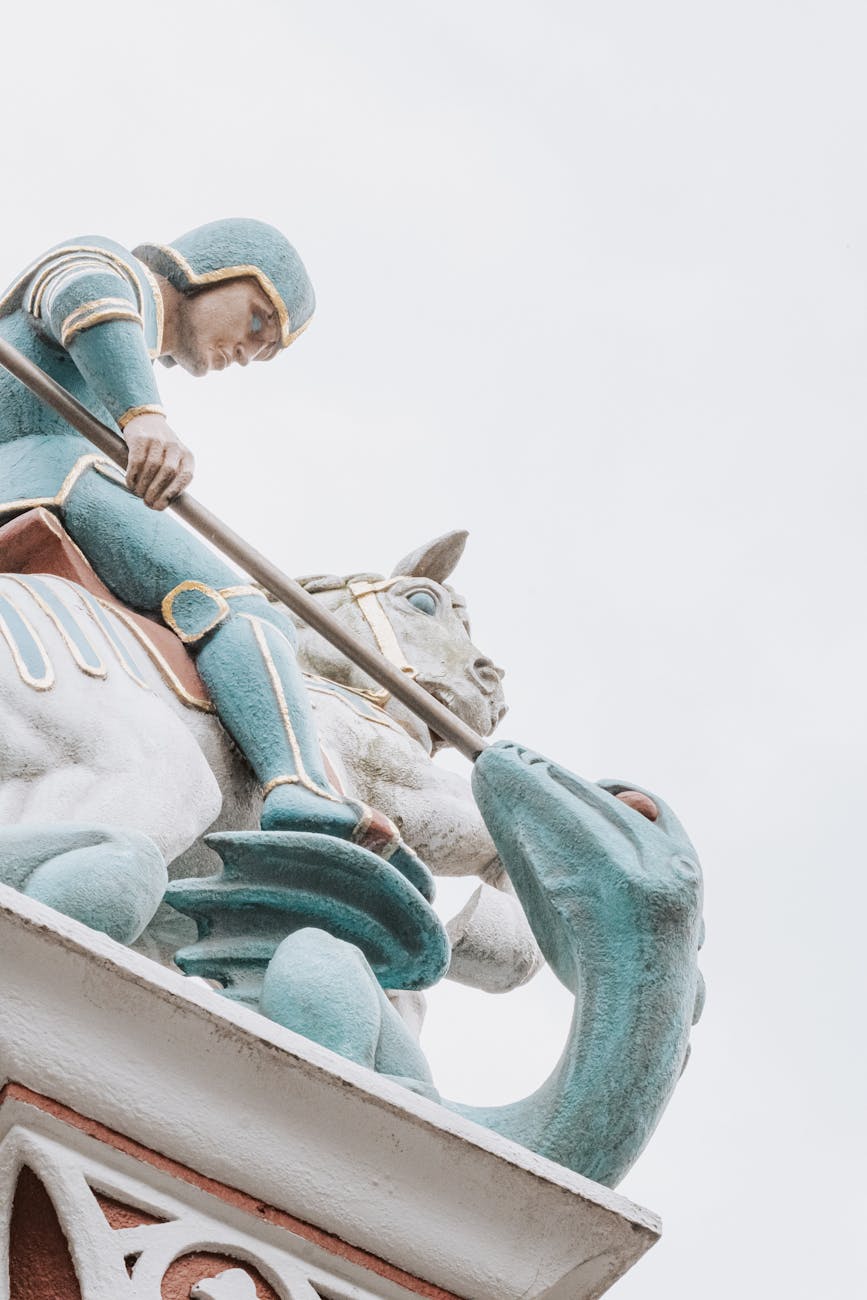
St George’s Day

St George is one of the most enduring figures in Christian tradition, revered as a martyr and the patron saint of England. Though much of his life is wrapped in legend, it’s generally believed that George was a Roman soldier born in the 3rd century in Cappadocia, a region in modern-day Turkey. He served under Emperor Diocletian but refused to renounce his Christian faith during a time of intense persecution. For this, he was tortured and ultimately executed, dying around the year 303.

The most famous legend surrounding St George is that of him slaying a dragon. According to the tale, a town was being terrorized by a dragon, and in a bid to appease it, the townspeople offered it sheep, and eventually, their own children. When a princess was chosen to be sacrificed, George intervened, tamed the dragon, and killed it, saving the princess and converting the town to Christianity. While clearly mythical, the story symbolizes the triumph of good over evil and faith over fear.

St George’s cult spread rapidly across Europe during the Middle Ages, and he became a symbol of chivalry and courage. He was adopted as the patron saint of England in the 14th century by Edward III, and his red cross on a white background became a national emblem. His feast day, April 23rd, is still celebrated in many countries. Despite the blurred lines between fact and legend, St George’s legacy remains one of steadfast faith and heroic virtue.

Windows is NOT the only OS

If you’re looking to revive an old computer or laptop you might like to consider an alternative operating system (OS). One that I use regularly on an old laptop is Linux Mint.

Linux Mint is a free, open-source operating system based on Ubuntu (or Debian in its alternative version), designed to be easy to use, reliable, and powerful. It’s particularly popular among users switching from Windows due to its familiar desktop layout and user-friendly interface. One of its core goals is to provide a complete out-of-the-box experience, meaning it comes pre-installed with essential software like a web browser, media players, office suite, and tools for everyday computing needs.

There are three main editions of Linux Mint, each using a different desktop environment: Cinnamon, MATE, and Xfce. Cinnamon is the flagship edition, offering a sleek, modern look with advanced features while staying lightweight and responsive. MATE and Xfce are aimed at users who need even lighter systems, especially for older hardware, while still maintaining a polished and functional interface.

Linux Mint emphasizes stability and simplicity. It uses the Linux kernel and a package management system that allows for secure, quick installation and updating of software. Its Update Manager is particularly praised for giving users more control over what updates are applied, allowing for a balance between cutting-edge features and system stability.

Security and privacy are also important aspects. While Linux in general is less vulnerable to malware than other operating systems, Linux Mint adds further layers of security through regular updates and strong community oversight.

The Linux Mint community is large and active, offering forums, documentation, and tutorials for users of all experience levels. Whether you’re a beginner or an experienced Linux user, Linux Mint provides a clean, consistent, and customizable environment that supports a wide range of use cases, from daily computing and programming to media production and education. Its commitment to user experience makes it a top choice among modern Linux distributions.

See also: 0patch Windows 10 EOS