
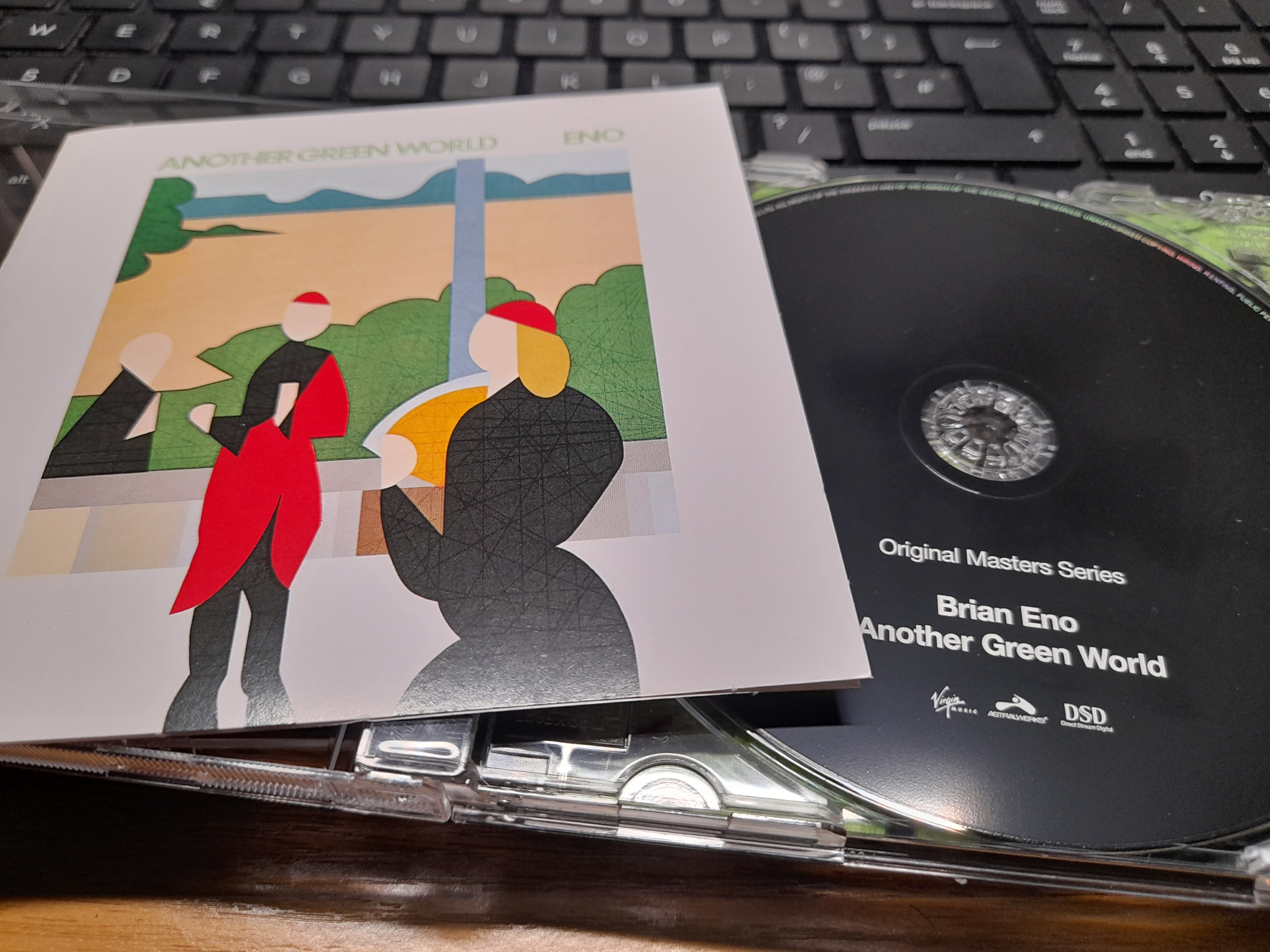
Another Green World was released fifty years ago today (14 November 1975), and it remains one of Brian Eno’s most influential records. Made during a period of transition in his career, it marks the moment when his interest in structured songs and his experiments with ambient sound began to blend. Sitting between Taking Tiger Mountain (By Strategy) and the fully ambient Music for Airports, it captures that shift happening in real time. About half the tracks feature vocals, while the rest are instrumentals shaped from tape treatments, early synthesisers, and Eno’s emerging Oblique Strategies approach to creative problem-solving.
Many pieces grew out of studio exploration, with musicians like Phil Collins, Percy Jones, and Robert Fripp improvising ideas that Eno later edited, repitched, or rebuilt. This process produced a collection of concise, carefully sculpted tracks, even when their origins were loose. St. Elmo’s Fire, with Fripp’s brilliantly serrated guitar line, sits comfortably beside quiet sketches like Becalmed and In Dark Trees, showing how easily the album moves between songcraft, texture, and atmosphere.
Another Green World made little commercial impact on release, but its importance has only increased. Its blend of ambient colour, inventive production, and understated melodic clarity shaped the development of electronic music, post-rock, art-pop, and film scoring. It’s now widely recognised as a landmark, not just in Eno’s catalogue, but in modern music as a whole.
Fifty years on, it hasn’t aged so much as matured into its own quiet authority. Each listen nudges me towards stillness, wonder, and a way of paying attention that feels almost like contemplation. It remains one of my favourite records because it never stops opening, and because it keeps teaching me how to breathe.
 John Ager's Home on the Web!